
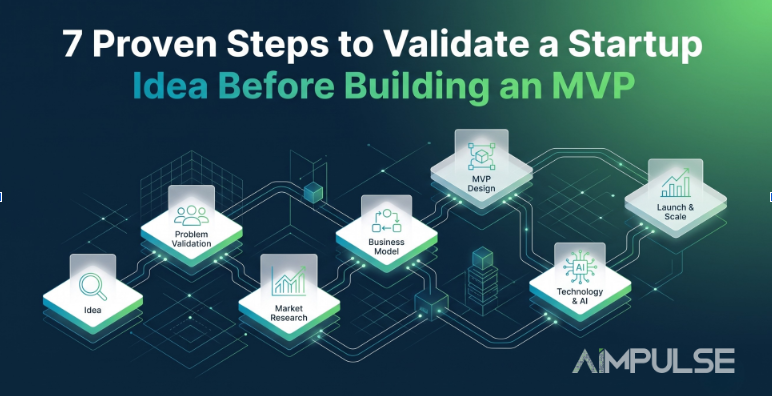
7 Proven Steps to Validate a Startup Idea Before Building
Introduction
Every year, thousands of startups invest months—and sometimes years—building products that never gain traction. The problem usually isn’t poor engineering or a lack of ambition. It’s that the product solves a problem nobody is actively trying to fix.
Learning how to validate a startup idea before writing a single line of code can save significant time, money, and effort. Validation helps founders understand whether there’s a real market, whether customers are willing to pay, and what the first version of the product should include.
At AImpulse Studio, we’ve seen the same pattern repeatedly: successful founders don’t begin with development—they begin with discovery. By combining product strategy, AI expertise, branding, and go-to-market planning, they reduce risk and increase the chances of building something customers genuinely need.
This guide walks through the exact seven-step framework we use to help founders move confidently from idea to launch.
7 Proven Steps to Validate a Startup Idea Before Building
7 Proven Steps to Validate a Startup Idea Before Building
7 Proven Steps to Validate a Startup Idea Before Building
7 Proven Steps to Validate a Startup Idea Before Building
7 Proven Steps to Validate a Startup Idea Before Building
7 Proven Steps to Validate a Startup Idea Before Building
7 Proven Steps to Validate a Startup Idea Before Building
7 Proven Steps to Validate a Startup Idea Before Building
7 Proven Steps to Validate a Startup Idea Before Building
7 Proven Steps to Validate a Startup Idea Before Building
7 Proven Steps to Validate a Startup Idea Before Building
Table of Contents
- Why Startup Validation Matters
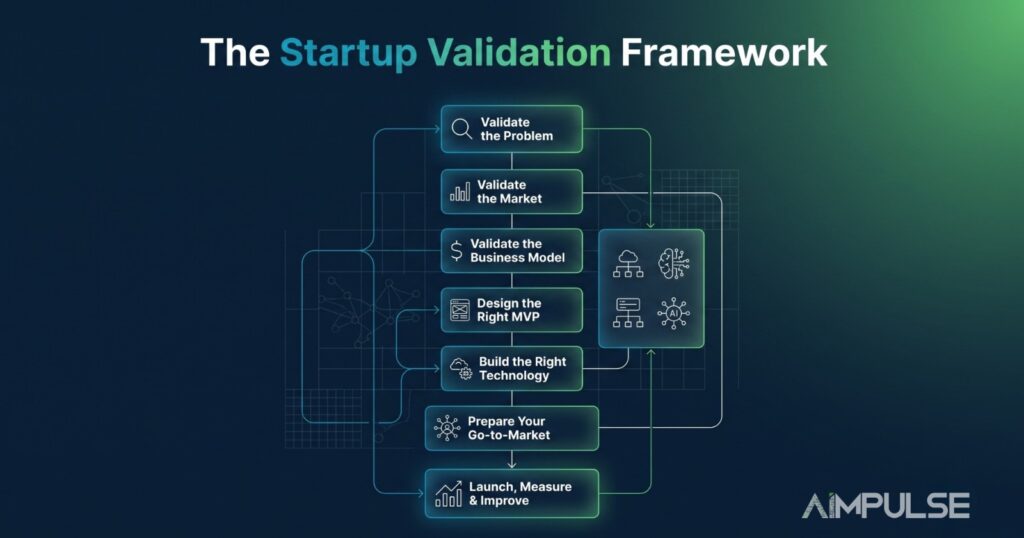
- Step 1: Validate the Problem
- Step 2: Validate the Market
- Step 3: Validate the Business Model
- Step 4: Design the Right MVP
- Step 5: Build the Right Technology
- Step 6: Prepare Your Go-to-Market Strategy
- Step 7: Launch, Measure, and Improve
- The AImpulse Studio Framework
- Frequently Asked Questions
Why Startup Validation Matters
One of the most cited startup studies from CB Insights found that the leading reason startups fail is building products with insufficient market demand.
Validation reduces uncertainty before major investments are made.
It helps founders answer questions such as:
- Is this a real problem?
- Who experiences it most?
- Are people willing to pay for a solution?
- Is the market large enough?
- Can AI create a meaningful competitive advantage?
The earlier these questions are answered, the lower the risk of expensive pivots later.
Step 1 — Validate the Problem
Before thinking about features, validate the problem itself.
Many founders fall in love with their solution before understanding whether the underlying challenge is significant enough for customers to care.
Practical Actions
- Interview 20–30 potential customers.
- Avoid pitching your solution.
- Ask about their current workflow.
- Understand how they solve the problem today.
- Identify recurring frustrations.
Instead of asking:
“Would you use my AI platform?”
Ask:
“Walk me through how you currently solve this problem.”
Patterns matter more than opinions.
If multiple people describe the same pain point independently, you’re moving in the right direction.
Step 2 — Validate the Market
A great problem still needs a viable market.
Research should answer:
- How many companies experience this issue?
- Which industries feel the pain most?
- How mature is the competition?
- Where can you differentiate?
Useful research sources include:
- Google Trends
- G2
- Product Hunt
- Reddit communities
- Industry reports
Estimate:
- Total Addressable Market (TAM)
- Serviceable Available Market (SAM)
- Serviceable Obtainable Market (SOM)
This exercise keeps expectations realistic while helping prioritize the right audience.
Step 3 — Validate the Business Model
A validated problem doesn’t automatically become a successful business.
Ask:
- Who pays?
- Why would they buy?
- What alternative are they replacing?
- How much value does your solution create?
Map your pricing assumptions early.
For B2B SaaS, consider:
- Monthly subscriptions
- Usage-based pricing
- Enterprise licensing
- Implementation services
The goal isn’t to perfect pricing—it is to prove customers see enough value to invest.
Mid-Article Call to Action
Many founders rush into development before validating demand.
At AImpulse Studio, we help entrepreneurs assess opportunities, prioritize features, and define an MVP that solves real business problems—not imagined ones.
Ready to validate your idea?
➡️ Explore AImpulse Studio
➡️ Book a Discovery Session
➡️ Follow AImpulse Studio on LinkedIn for practical product-building insights.
Step 4 — Design the Right MVP
An MVP (Minimum Viable Product) is not a smaller version of the final product.
It’s the smallest solution capable of validating your biggest assumptions.
Prioritize features using the MoSCoW Framework:
Must Have
Core functionality users cannot live without.
Should Have
Important enhancements that improve usability.
Could Have
Nice additions that can wait.
Won’t Have (Yet)
Ideas intentionally postponed until future iterations.
Building less often leads to learning more.
Step 5 — Build the Right Technology
Technology should support business goals—not dictate them.
Before development begins, define:
- Product architecture
- AI opportunities
- Security requirements
- Scalability
- Compliance considerations
- Integration needs
Sometimes a no-code MVP is sufficient.
Sometimes a custom AI platform is the better investment.
The right decision depends on business objectives, not technology trends.
Step 6 — Prepare Your Go-to-Market Strategy
Many startups spend six months building and only two weeks planning their launch.
That imbalance often limits early traction.
A successful go-to-market strategy includes:
- Brand positioning
- Clear messaging
- Landing page
- Website
- SEO strategy
- LinkedIn presence
- Email marketing
- Product demonstrations
- Analytics setup
Technology creates the product.
Marketing creates demand.
Both must evolve together.
Step 7 — Launch, Measure, and Improve
Launching isn’t the finish line.
It’s the beginning of continuous learning.
Track:
- Customer acquisition
- Activation
- Retention
- Feature usage
- Churn
- Revenue
- Customer feedback
Every release should answer one question:
“What did we learn?”
The fastest learning teams usually build the strongest products.
The AImpulse Studio Framework
Every successful product follows a repeatable journey.
Discover
Understand the business, users, and opportunity.
↓
Validate
Confirm demand before investing.
↓
Design
Create the product strategy and roadmap.
↓
Build
Develop a scalable MVP.
↓
Launch
Release to real users.
↓
Grow
Optimize marketing, SEO, and customer acquisition.
↓
Scale
Expand features, automation, and AI capabilities.
Unlike traditional software agencies, AImpulse Studio supports founders across this entire lifecycle—combining AI engineering with branding, positioning, SEO, and go-to-market execution alongside Teddy Tech Solutions.
Why Founders Choose AImpulse Studio
Most founders end up hiring:
- A developer
- A designer
- A branding agency
- A marketing consultant
- An SEO specialist
- A product strategist
Managing multiple vendors often slows progress and creates disconnected decisions.
AImpulse Studio brings these disciplines together under one collaborative framework, helping founders move from idea to market with a single strategic partner.
Frequently Asked Questions
How do I validate a startup idea?
Start by interviewing potential customers, researching competitors, validating market demand, and testing your assumptions before investing in development.
What is an MVP?
An MVP (Minimum Viable Product) is the simplest version of a product that allows you to validate your idea with real users while minimizing time and cost.
Should I build before validating?
No. Validation helps reduce risk by confirming that customers have a genuine problem worth solving before development begins.
How long does startup validation take?
Depending on the complexity of the idea, validation can often be completed in two to six weeks through customer interviews, market research, and prototype testing.
Can AI help validate business ideas?
Yes. AI can support market research, competitor analysis, customer segmentation, rapid prototyping, and data analysis, but direct conversations with potential customers remain essential.
Conclusion
Knowing how to validate a startup idea is one of the most valuable skills a founder can develop. Great businesses rarely begin with code—they begin with a deep understanding of customer problems, thoughtful validation, and disciplined execution.
At AImpulse Studio, we combine AI development, product strategy, branding, and go-to-market expertise to help founders move confidently from concept to launch. Whether you’re refining an idea, building an MVP, or preparing for market entry, our team is here to guide every stage of the journey.
Ready to build with confidence?
- 🚀 Explore the AImpulse Studio page.
- 📅 Book a discovery session through our contact form.
- 💼 Follow AImpulse Studio on LinkedIn for founder insights, product-building frameworks, and practical AI guidance.
Introduction
Every year, thousands of startups invest months—and sometimes years—building products that never gain traction. The problem usually isn’t poor engineering or a lack of ambition. It’s that the product solves a problem nobody is actively trying to fix.
Learning how to validate a startup idea before writing a single line of code can save significant time, money, and effort. Validation helps founders understand whether there’s a real market, whether customers are willing to pay, and what the first version of the product should include.
At AImpulse Studio, we’ve seen the same pattern repeatedly: successful founders don’t begin with development—they begin with discovery. By combining product strategy, AI expertise, branding, and go-to-market planning, they reduce risk and increase the chances of building something customers genuinely need.
This guide walks through the exact seven-step framework we use to help founders move confidently from idea to launch.
Table of Contents
- Why Startup Validation Matters
- Step 1: Validate the Problem
- Step 2: Validate the Market
- Step 3: Validate the Business Model
- Step 4: Design the Right MVP
- Step 5: Build the Right Technology
- Step 6: Prepare Your Go-to-Market Strategy
- Step 7: Launch, Measure, and Improve
- The AImpulse Studio Framework
- Frequently Asked Questions
Why Startup Validation Matters
One of the most cited startup studies from CB Insights found that the leading reason startups fail is building products with insufficient market demand.
Validation reduces uncertainty before major investments are made.
It helps founders answer questions such as:
- Is this a real problem?
- Who experiences it most?
- Are people willing to pay for a solution?
- Is the market large enough?
- Can AI create a meaningful competitive advantage?
The earlier these questions are answered, the lower the risk of expensive pivots later.
Step 1 — Validate the Problem
Before thinking about features, validate the problem itself.
Many founders fall in love with their solution before understanding whether the underlying challenge is significant enough for customers to care.
Practical Actions
- Interview 20–30 potential customers.
- Avoid pitching your solution.
- Ask about their current workflow.
- Understand how they solve the problem today.
- Identify recurring frustrations.
Instead of asking:
“Would you use my AI platform?”
Ask:
“Walk me through how you currently solve this problem.”
Patterns matter more than opinions.
If multiple people describe the same pain point independently, you’re moving in the right direction.
Step 2 — Validate the Market
A great problem still needs a viable market.
Research should answer:
- How many companies experience this issue?
- Which industries feel the pain most?
- How mature is the competition?
- Where can you differentiate?
Useful research sources include:
- Google Trends
- G2
- Product Hunt
- Reddit communities
- Industry reports
Estimate:
- Total Addressable Market (TAM)
- Serviceable Available Market (SAM)
- Serviceable Obtainable Market (SOM)
This exercise keeps expectations realistic while helping prioritize the right audience.
Step 3 — Validate the Business Model
A validated problem doesn’t automatically become a successful business.
Ask:
- Who pays?
- Why would they buy?
- What alternative are they replacing?
- How much value does your solution create?
Map your pricing assumptions early.
For B2B SaaS, consider:
- Monthly subscriptions
- Usage-based pricing
- Enterprise licensing
- Implementation services
The goal isn’t to perfect pricing—it is to prove customers see enough value to invest.
Many founders rush into development before validating demand.
At AImpulse Studio, we help entrepreneurs assess opportunities, prioritize features, and define an MVP that solves real business problems—not imagined ones.
Ready to validate your idea?
➡️ Explore AImpulse Studio
➡️ Book a Discovery Session
➡️ Follow AImpulse Studio on LinkedIn for practical product-building insights.
Step 4 — Design the Right MVP
An MVP (Minimum Viable Product) is not a smaller version of the final product.
It’s the smallest solution capable of validating your biggest assumptions.
Prioritize features using the MoSCoW Framework:
Must Have
Core functionality users cannot live without.
Should Have
Important enhancements that improve usability.
Could Have
Nice additions that can wait.
Won’t Have (Yet)
Ideas intentionally postponed until future iterations.
Building less often leads to learning more.
Step 5 — Build the Right Technology
Technology should support business goals—not dictate them.
Before development begins, define:
- Product architecture
- AI opportunities
- Security requirements
- Scalability
- Compliance considerations
- Integration needs
Sometimes a no-code MVP is sufficient.
Sometimes a custom AI platform is the better investment.
The right decision depends on business objectives, not technology trends.
Step 6 — Prepare Your Go-to-Market Strategy
Many startups spend six months building and only two weeks planning their launch.
That imbalance often limits early traction.
A successful go-to-market strategy includes:
- Brand positioning
- Clear messaging
- Landing page
- Website
- SEO strategy
- LinkedIn presence
- Email marketing
- Product demonstrations
- Analytics setup
Technology creates the product.
Marketing creates demand.
Both must evolve together.
Step 7 — Launch, Measure, and Improve
Launching isn’t the finish line.
It’s the beginning of continuous learning.
Track:
- Customer acquisition
- Activation
- Retention
- Feature usage
- Churn
- Revenue
- Customer feedback
Every release should answer one question:
“What did we learn?”
The fastest learning teams usually build the strongest products.
The AImpulse Studio Framework
Every successful product follows a repeatable journey.
Discover
Understand the business, users, and opportunity.
↓
Validate
Confirm demand before investing.
↓
Design
Create the product strategy and roadmap.
↓
Build
Develop a scalable MVP.
↓
Launch
Release to real users.
↓
Grow
Optimize marketing, SEO, and customer acquisition.
↓
Scale
Expand features, automation, and AI capabilities.
Unlike traditional software agencies, AImpulse Studio supports founders across this entire lifecycle—combining AI engineering with branding, positioning, SEO, and go-to-market execution alongside Teddy Tech Solutions.
Why Founders Choose AImpulse Studio
Most founders end up hiring:
- A developer
- A designer
- A branding agency
- A marketing consultant
- An SEO specialist
- A product strategist
Managing multiple vendors often slows progress and creates disconnected decisions.
AImpulse Studio brings these disciplines together under one collaborative framework, helping founders move from idea to market with a single strategic partner.
Frequently Asked Questions
How do I validate a startup idea?
Start by interviewing potential customers, researching competitors, validating market demand, and testing your assumptions before investing in development.
What is an MVP?
An MVP (Minimum Viable Product) is the simplest version of a product that allows you to validate your idea with real users while minimizing time and cost.
Should I build before validating?
No. Validation helps reduce risk by confirming that customers have a genuine problem worth solving before development begins.
How long does startup validation take?
Depending on the complexity of the idea, validation can often be completed in two to six weeks through customer interviews, market research, and prototype testing.
Can AI help validate business ideas?
Yes. AI can support market research, competitor analysis, customer segmentation, rapid prototyping, and data analysis, but direct conversations with potential customers remain essential.
Conclusion
Knowing how to validate a startup idea is one of the most valuable skills a founder can develop. Great businesses rarely begin with code—they begin with a deep understanding of customer problems, thoughtful validation, and disciplined execution.
At AImpulse Studio, we combine AI development, product strategy, branding, and go-to-market expertise to help founders move confidently from concept to launch. Whether you’re refining an idea, building an MVP, or preparing for market entry, our team is here to guide every stage of the journey.
Ready to build with confidence?
- 🚀 Explore the AImpulse Studio page.
- 📅 Book a discovery session through our contact form.
- 💼 Follow AImpulse Studio on LinkedIn for founder insights, product-building frameworks, and practical AI guidance.