

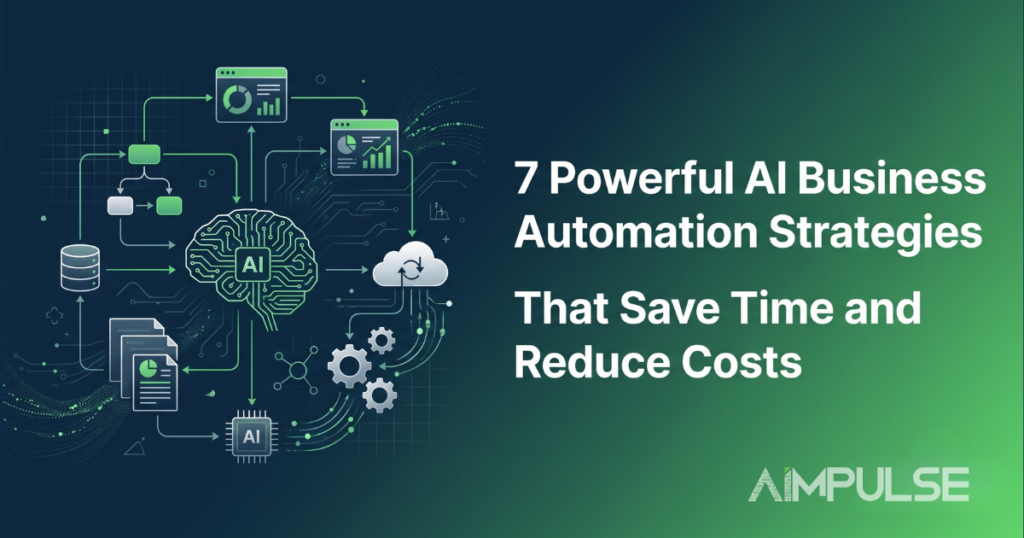
7 Powerful AI Business Automation Strategies That Save Time and Reduce Costs
URL Slug
ai-business-automation
Meta Description
Discover how AI business automation helps companies reduce costs, improve productivity, and scale faster with practical implementation strategies and real business examples.
Featured Image
Alt Text:
AI business automation strategies helping organizations improve productivity and reduce operational costs with intelligent workflows.
7 Powerful AI Business Automation Strategies That Save Time and Reduce Costs
Artificial intelligence is no longer reserved for large enterprises with massive technology budgets. Today, AI business automation is becoming one of the fastest ways for organizations of every size to improve efficiency, reduce operational costs, and scale without dramatically increasing headcount.
Across Europe and the MENA region, businesses are adopting AI to automate repetitive work, accelerate decision-making, and create better customer experiences. From customer support and logistics to finance and marketing, organizations are discovering that AI isn’t replacing people—it’s empowering them to focus on higher-value work.
In this guide, we’ll explore the most impactful AI business automation strategies, practical implementation steps, and how your business can start benefiting from AI today.
Table of Contents
- What Is AI Business Automation?
- Why Businesses Are Investing in AI Automation
- 7 Powerful AI Business Automation Strategies
- How to Implement AI Business Automation
- Common Mistakes to Avoid
- The AImpulse AI Automation Framework
- How AImpulse Helps
- Frequently Asked Questions
- Conclusion
What Is AI Business Automation?
AI business automation is the use of artificial intelligence technologies—including machine learning, natural language processing (NLP), computer vision, and predictive analytics—to automate business processes that traditionally required human effort.
Unlike traditional automation, which follows fixed rules, AI-powered automation can learn from data, recognize patterns, and make intelligent decisions.
Examples include:
- AI-powered customer service chatbots
- Automated invoice processing
- Intelligent document classification
- Predictive demand forecasting
- AI-assisted sales recommendations
- Workflow automation across departments
Rather than replacing employees, AI handles repetitive and time-consuming tasks, allowing teams to focus on innovation, customer relationships, and strategic growth.
Why Businesses Are Investing in AI Automation
Organizations are under increasing pressure to deliver faster services while controlling operational costs. AI automation helps companies meet these challenges without compromising quality.
Increased Productivity
Employees spend less time on repetitive administrative work and more time solving complex business challenges.
Reduced Operational Costs
Automating repetitive workflows lowers labor costs, reduces manual errors, and improves efficiency across departments.
Better Decision-Making
AI analyzes massive datasets in seconds, helping leadership teams make faster, data-driven decisions.
Improved Customer Experience
AI enables faster responses, personalized recommendations, and 24/7 customer support.
Scalable Growth
As businesses grow, AI scales operations without requiring proportional increases in staffing.
Organizations that embrace enterprise AI automation today position themselves for long-term competitive advantage.
7 Powerful AI Business Automation Strategies
1. Automate Customer Support
Customer support is one of the most common applications of AI.
Modern AI assistants can:
- Answer frequently asked questions
- Route support tickets automatically
- Provide multilingual support
- Escalate complex requests to human agents
- Operate 24/7
This improves customer satisfaction while significantly reducing response times.
2. Automate Internal Workflows
Many organizations still rely on manual approvals, spreadsheets, and email chains.
AI workflow automation simplifies processes such as:
- Employee onboarding
- Leave requests
- Document approvals
- Purchase requests
- Contract management
Instead of chasing emails, employees can focus on productive work.
3. Automate Sales Processes
Sales teams generate enormous amounts of customer data every day.
AI helps automate:
- Lead qualification
- CRM updates
- Sales forecasting
- Opportunity scoring
- Follow-up reminders
Sales representatives spend less time on administrative work and more time building relationships.
4. Automate Marketing
Marketing teams are increasingly using AI to improve campaign performance.
AI can assist with:
- Content generation
- Email personalization
- Audience segmentation
- Campaign optimization
- Performance reporting
Rather than replacing marketers, AI provides better insights that improve campaign results.
5. Automate Human Resources
HR departments handle thousands of repetitive tasks.
AI simplifies:
- Resume screening
- Interview scheduling
- Employee onboarding
- Internal knowledge assistants
- Performance analytics
Recruitment becomes faster while improving candidate experience.
6. Automate Financial Operations
Finance teams benefit enormously from intelligent automation.
AI can automate:
- Invoice processing
- Expense categorization
- Financial reporting
- Fraud detection
- Cash flow forecasting
This reduces errors while improving financial visibility.
7. Automate Business Intelligence
Executives need real-time insights—not weekly reports.
AI-powered analytics can:
- Detect anomalies
- Predict future trends
- Identify business opportunities
- Generate executive dashboards
- Recommend operational improvements
Companies move from reactive management to proactive decision-making.
How to Implement AI Business Automation
Successful AI transformation doesn’t begin with replacing every process overnight.
Instead, it starts with solving one meaningful business problem.
Step 1 — Identify Repetitive Tasks
Look for activities that consume significant employee time but follow predictable patterns.
Examples include:
- Data entry
- Invoice processing
- Customer inquiries
- Scheduling
- Reporting
These are ideal automation candidates.
Step 2 — Prioritize High-Impact Opportunities
Not every process should be automated first.
Evaluate opportunities based on:
- Time savings
- Business impact
- Implementation complexity
- Return on investment
Quick wins build confidence and create momentum for future projects.
Step 3 — Prepare Your Data
AI depends on quality data.
Ensure your business data is:
- Accurate
- Consistent
- Secure
- Well organized
Poor data produces poor AI results.
Step 4 — Start with a Pilot Project
Instead of launching organization-wide automation, begin with one focused initiative.
A pilot allows you to:
- Validate business value
- Measure ROI
- Gather employee feedback
- Improve before scaling
Considering AI for Your Business?
Most successful AI transformations begin with one well-defined automation project.
Whether you’re exploring intelligent document processing, workflow automation, or AI-powered customer experiences, starting small often leads to the biggest long-term impact.
Explore AImpulse Studio to discover how your first AI automation initiative could create measurable business value.
Step 5 — Scale Gradually
Once your first project delivers measurable results:
- Expand to additional departments
- Integrate more systems
- Continuously optimize AI models
- Monitor business performance
AI automation is an ongoing business capability—not a one-time technology project.
Common Mistakes to Avoid
Many AI initiatives fail because organizations focus on technology instead of business value.
Automating Broken Processes
AI cannot fix inefficient workflows.
Optimize the process before automating it.
Ignoring Employees
Successful AI adoption requires change management.
Train employees and explain how AI supports—not replaces—their work.
Poor Data Quality
Incomplete or inconsistent data leads to unreliable AI decisions.
Invest in data governance early.
Unrealistic Expectations
AI delivers the best results through continuous improvement.
Treat automation as an evolving business capability.
The AImpulse AI Automation Framework
At AImpulse, we believe AI automation should always begin with business outcomes—not technology.
Our proven framework helps organizations implement AI with confidence.
Discover
Identify repetitive workflows and business bottlenecks.
↓
Map
Analyze existing business processes and identify automation opportunities.
↓
Automate
Design and build intelligent AI-powered workflows.
↓
Optimize
Measure performance, improve accuracy, and refine AI models.
↓
Scale
Expand successful automation initiatives across departments and business units.
This structured approach helps organizations reduce implementation risks while maximizing long-term ROI.
How AImpulse Helps
Every organization has unique challenges.
That’s why we don’t offer one-size-fits-all AI solutions.
Our team helps businesses:
- Discover high-impact AI opportunities
- Validate automation initiatives
- Design scalable AI architectures
- Develop secure AI applications
- Integrate AI into existing systems
- Measure business outcomes
From startups launching their first AI product to enterprises modernizing complex operations, we help organizations transform ideas into measurable business value.
Whether you’re looking to automate operations, build AI-powered software, or validate a new product idea, AImpulse Studio provides the strategic and technical expertise to guide every stage of the journey.
Frequently Asked Questions
What is AI business automation?
AI business automation uses artificial intelligence to automate repetitive business processes, improve operational efficiency, and support better decision-making through intelligent software systems.
Which business processes can AI automate?
AI can automate customer support, finance, HR, logistics, sales, marketing, reporting, document processing, forecasting, and many other repetitive workflows.
Is AI automation suitable for small businesses?
Yes. Many SMEs begin with one automation project before expanding across their organization. Starting small helps reduce risk while demonstrating measurable ROI.
How long does AI automation implementation take?
Simple AI automation projects can often be implemented within a few weeks, while larger enterprise initiatives may require several months depending on complexity.
Do businesses need large amounts of data to start?
Not always. Many AI solutions leverage existing business data or pre-trained AI models, allowing organizations to begin with relatively small datasets and improve over time.
Conclusion
AI business automation is no longer a future initiative—it’s a competitive advantage available today.
Organizations that automate repetitive work gain more than efficiency. They create faster operations, empower employees, improve customer experiences, and build the flexibility needed to scale in an increasingly digital economy.
The most successful companies don’t automate everything at once. They identify one meaningful opportunity, validate its impact, and build from there.
At AImpulse, we help businesses take that first step with confidence—combining AI engineering, product strategy, and business expertise to design automation solutions that deliver measurable results.
If you’re ready to explore how AI can transform your operations, visit AImpulse Studio, book a discovery session, or connect with us on LinkedIn to follow our latest insights on AI, product development, and digital transformation.
Artificial intelligence is no longer reserved for large enterprises with massive technology budgets. Today, AI business automation is becoming one of the fastest ways for organizations of every size to improve efficiency, reduce operational costs, and scale without dramatically increasing headcount.
Across Europe and the MENA region, businesses are adopting AI to automate repetitive work, accelerate decision-making, and create better customer experiences. From customer support and logistics to finance and marketing, organizations are discovering that AI isn’t replacing people—it’s empowering them to focus on higher-value work.
In this guide, we’ll explore the most impactful AI business automation strategies, practical implementation steps, and how your business can start benefiting from AI today.
Table of Contents
- What Is AI Business Automation?
- Why Businesses Are Investing in AI Automation
- 7 Powerful AI Business Automation Strategies
- How to Implement AI Business Automation
- Common Mistakes to Avoid
- The AImpulse AI Automation Framework
- How AImpulse Helps
- Frequently Asked Questions
- Conclusion
What Is AI Business Automation?
AI business automation is the use of artificial intelligence technologies—including machine learning, natural language processing (NLP), computer vision, and predictive analytics—to automate business processes that traditionally required human effort.
Unlike traditional automation, which follows fixed rules, AI-powered automation can learn from data, recognize patterns, and make intelligent decisions.
Examples include:
- AI-powered customer service chatbots
- Automated invoice processing
- Intelligent document classification
- Predictive demand forecasting
- AI-assisted sales recommendations
- Workflow automation across departments
Rather than replacing employees, AI handles repetitive and time-consuming tasks, allowing teams to focus on innovation, customer relationships, and strategic growth.
Why Businesses Are Investing in AI Automation
Organizations are under increasing pressure to deliver faster services while controlling operational costs. AI automation helps companies meet these challenges without compromising quality.
Increased Productivity
Employees spend less time on repetitive administrative work and more time solving complex business challenges.
Reduced Operational Costs
Automating repetitive workflows lowers labor costs, reduces manual errors, and improves efficiency across departments.
Better Decision-Making
AI analyzes massive datasets in seconds, helping leadership teams make faster, data-driven decisions.
Improved Customer Experience
AI enables faster responses, personalized recommendations, and 24/7 customer support.
Scalable Growth
As businesses grow, AI scales operations without requiring proportional increases in staffing.
Organizations that embrace enterprise AI automation today position themselves for long-term competitive advantage.
7 Powerful AI Business Automation Strategies
1. Automate Customer Support
Customer support is one of the most common applications of AI.
Modern AI assistants can:
- Answer frequently asked questions
- Route support tickets automatically
- Provide multilingual support
- Escalate complex requests to human agents
- Operate 24/7
This improves customer satisfaction while significantly reducing response times.
2. Automate Internal Workflows
Many organizations still rely on manual approvals, spreadsheets, and email chains.
AI workflow automation simplifies processes such as:
- Employee onboarding
- Leave requests
- Document approvals
- Purchase requests
- Contract management
Instead of chasing emails, employees can focus on productive work.
3. Automate Sales Processes
Sales teams generate enormous amounts of customer data every day.
AI helps automate:
- Lead qualification
- CRM updates
- Sales forecasting
- Opportunity scoring
- Follow-up reminders
Sales representatives spend less time on administrative work and more time building relationships.
4. Automate Marketing
Marketing teams are increasingly using AI to improve campaign performance.
AI can assist with:
- Content generation
- Email personalization
- Audience segmentation
- Campaign optimization
- Performance reporting
Rather than replacing marketers, AI provides better insights that improve campaign results.
5. Automate Human Resources
HR departments handle thousands of repetitive tasks.
AI simplifies:
- Resume screening
- Interview scheduling
- Employee onboarding
- Internal knowledge assistants
- Performance analytics
Recruitment becomes faster while improving candidate experience.
6. Automate Financial Operations
Finance teams benefit enormously from intelligent automation.
AI can automate:
- Invoice processing
- Expense categorization
- Financial reporting
- Fraud detection
- Cash flow forecasting
This reduces errors while improving financial visibility.
7. Automate Business Intelligence
Executives need real-time insights—not weekly reports.
AI-powered analytics can:
- Detect anomalies
- Predict future trends
- Identify business opportunities
- Generate executive dashboards
- Recommend operational improvements
Companies move from reactive management to proactive decision-making.
How to Implement AI Business Automation
Successful AI transformation doesn’t begin with replacing every process overnight.
Instead, it starts with solving one meaningful business problem.
Step 1 — Identify Repetitive Tasks
Look for activities that consume significant employee time but follow predictable patterns.
Examples include:
- Data entry
- Invoice processing
- Customer inquiries
- Scheduling
- Reporting
These are ideal automation candidates.
Step 2 — Prioritize High-Impact Opportunities
Not every process should be automated first.
Evaluate opportunities based on:
- Time savings
- Business impact
- Implementation complexity
- Return on investment
Quick wins build confidence and create momentum for future projects.
Step 3 — Prepare Your Data
AI depends on quality data.
Ensure your business data is:
- Accurate
- Consistent
- Secure
- Well organized
Poor data produces poor AI results.
Step 4 — Start with a Pilot Project
Instead of launching organization-wide automation, begin with one focused initiative.
A pilot allows you to:
- Validate business value
- Measure ROI
- Gather employee feedback
- Improve before scaling
Considering AI for Your Business?
Most successful AI transformations begin with one well-defined automation project.
Whether you’re exploring intelligent document processing, workflow automation, or AI-powered customer experiences, starting small often leads to the biggest long-term impact.
Explore AImpulse Studio to discover how your first AI automation initiative could create measurable business value.
Step 5 — Scale Gradually
Once your first project delivers measurable results:
- Expand to additional departments
- Integrate more systems
- Continuously optimize AI models
- Monitor business performance
AI automation is an ongoing business capability—not a one-time technology project.
Common Mistakes to Avoid
Many AI initiatives fail because organizations focus on technology instead of business value.
Automating Broken Processes
AI cannot fix inefficient workflows.
Optimize the process before automating it.
Ignoring Employees
Successful AI adoption requires change management.
Train employees and explain how AI supports—not replaces—their work.
Poor Data Quality
Incomplete or inconsistent data leads to unreliable AI decisions.
Invest in data governance early.
Unrealistic Expectations
AI delivers the best results through continuous improvement.
Treat automation as an evolving business capability.
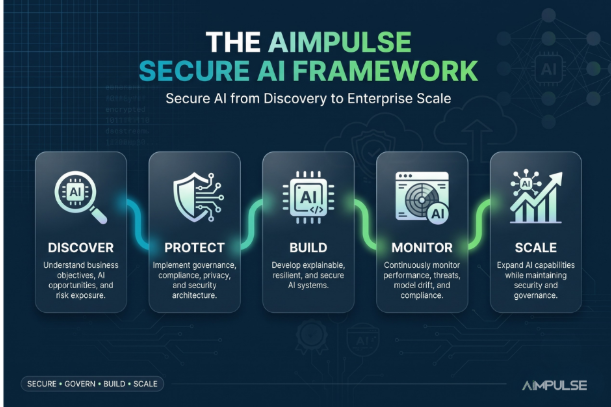
The AImpulse AI Automation Framework
At AImpulse, we believe AI automation should always begin with business outcomes—not technology.
Our proven framework helps organizations implement AI with confidence.
Discover
Identify repetitive workflows and business bottlenecks.
↓
Map
Analyze existing business processes and identify automation opportunities.
↓
Automate
Design and build intelligent AI-powered workflows.
↓
Optimize
Measure performance, improve accuracy, and refine AI models.
↓
Scale
Expand successful automation initiatives across departments and business units.
This structured approach helps organizations reduce implementation risks while maximizing long-term ROI.
How AImpulse Helps
Every organization has unique challenges.
That’s why we don’t offer one-size-fits-all AI solutions.
Our team helps businesses:
- Discover high-impact AI opportunities
- Validate automation initiatives
- Design scalable AI architectures
- Develop secure AI applications
- Integrate AI into existing systems
- Measure business outcomes
From startups launching their first AI product to enterprises modernizing complex operations, we help organizations transform ideas into measurable business value.
Whether you’re looking to automate operations, build AI-powered software, or validate a new product idea, AImpulse Studio provides the strategic and technical expertise to guide every stage of the journey.
Frequently Asked Questions
What is AI business automation?
AI business automation uses artificial intelligence to automate repetitive business processes, improve operational efficiency, and support better decision-making through intelligent software systems.
Which business processes can AI automate?
AI can automate customer support, finance, HR, logistics, sales, marketing, reporting, document processing, forecasting, and many other repetitive workflows.
Is AI automation suitable for small businesses?
Yes. Many SMEs begin with one automation project before expanding across their organization. Starting small helps reduce risk while demonstrating measurable ROI.
How long does AI automation implementation take?
Simple AI automation projects can often be implemented within a few weeks, while larger enterprise initiatives may require several months depending on complexity.
Do businesses need large amounts of data to start?
Not always. Many AI solutions leverage existing business data or pre-trained AI models, allowing organizations to begin with relatively small datasets and improve over time.
Conclusion
AI business automation is no longer a future initiative—it’s a competitive advantage available today.
Organizations that automate repetitive work gain more than efficiency. They create faster operations, empower employees, improve customer experiences, and build the flexibility needed to scale in an increasingly digital economy.
The most successful companies don’t automate everything at once. They identify one meaningful opportunity, validate its impact, and build from there.
At AImpulse, we help businesses take that first step with confidence—combining AI engineering, product strategy, and business expertise to design automation solutions that deliver measurable results.
Ready to build with confidence?
- 🚀 Explore the AImpulse Studio page.
- 📅 Book a discovery session through our contact form.
- 💼 Follow AImpulse Studio on LinkedIn for founder insights, product-building frameworks, and practical AI guidance.