


Cloud-Native Architecture Explained: Why Modern Businesses Are Leaving Legacy Systems Behind
Cloud-native architecture has moved from a niche engineering preference to the default standard for enterprises that need to scale reliably, ship faster, and control infrastructure costs. For European CTOs and enterprise architects still running critical workloads on monolithic, on-premise systems, the gap between what legacy infrastructure can deliver and what the business now demands keeps widening every quarter.
This article explains what cloud-native architecture actually means, why legacy systems are being retired faster than ever, the core principles behind modern cloud platforms, and a practical framework for making the transition without disrupting the business.
Table of Contents
- What is cloud-native architecture?
- Why businesses are moving away from legacy systems
- Core principles of cloud-native architecture
- Benefits of cloud-native architecture
- Common mistakes
- The AImpulse Cloud Transformation Framework
- FAQ
What is Cloud-Native Architecture?
Cloud-Native Architecture Explained
Cloud-Native Architecture Explained
Cloud-Native Architecture Explained
Cloud-Native Architecture Explained
Cloud-Native Architecture ExplainedCloud-Native Architecture Explained
Cloud-Native Architecture Explained
Cloud-Native Architecture Explained
Cloud-Native Architecture Explained
Cloud-Native Architecture Explained
Cloud-Native Architecture Explained
Cloud-Native Architecture Explained
Cloud-Native Architecture Explained
Cloud-Native Architecture Explained
Cloud-Native Architecture Explained
Cloud-Native Architecture Explained
Cloud-native architecture is an approach to designing and running software that fully exploits the cloud computing model — rather than simply lifting an existing application onto a cloud server. It relies on containers, microservices, dynamic orchestration, and automated pipelines to build systems that are resilient, scalable, and independently deployable.
Where a legacy application is typically one large codebase deployed as a single unit, a cloud-native system is broken into smaller, loosely coupled services that can be updated, scaled, and recovered independently — without taking the entire platform offline.
Why Businesses Are Moving Away from Legacy Systems
Legacy systems were built for a world of predictable load, infrequent releases, and on-premise data centers. Today’s enterprises operate under very different conditions.
- Release velocity has become a competitive requirement. Monolithic systems often require full regression testing for even minor changes, slowing releases from days to months.
- Scaling legacy infrastructure means buying more hardware. Cloud-native systems scale elastically, adding capacity only when demand requires it.
- Maintenance cost keeps climbing. Aging systems depend on scarce specialist skills and unsupported software versions, increasing operational risk.
- Compliance expectations are rising. European regulations such as GDPR and the EU AI Act increasingly require auditability and data traceability that legacy architectures were never designed to provide.
The result is a steady, accelerating migration toward cloud-native architecture across finance, retail, manufacturing, and the public sector.
Core Principles of Cloud-Native Architecture
Cloud-native architecture rests on a set of interlocking technical principles rather than a single technology.
Containers
Containers package an application and its dependencies together, ensuring it runs consistently across development, testing, and production environments. Docker remains the most widely adopted container runtime for this purpose.
Microservices
Instead of one large application, functionality is split into small, independently deployable services — each owning a specific business capability, such as billing, authentication, or notifications.
Kubernetes
Kubernetes automates the deployment, scaling, and recovery of containerized services. It has become the de facto orchestration standard, governed under the Cloud Native Computing Foundation (CNCF).
CI/CD
Continuous integration and continuous delivery pipelines automate testing and deployment, allowing teams to ship changes safely, frequently, and with far less manual intervention.
Observability
Cloud-native systems depend on structured logging, metrics, and distributed tracing to give engineering teams real-time visibility into system health across many independent services.
API-First Design
Every service exposes a well-documented API, allowing internal teams, partners, and external systems to integrate without direct access to underlying code or data stores.
Benefits of Cloud-Native Architecture
- Faster time to market, since teams can deploy individual services without waiting on a full release cycle.
- Elastic scalability, handling demand spikes automatically instead of over-provisioning hardware in advance.
- Improved resilience, since a failure in one microservice doesn’t necessarily bring down the entire platform.
- Lower long-term infrastructure cost, through pay-as-you-go cloud consumption rather than fixed capital expenditure.
- Stronger security posture, with smaller attack surfaces per service and automated patching pipelines.
- Better compliance readiness, thanks to built-in observability and audit trails across distributed systems.
Common Mistakes in Cloud-Native Migration
Many enterprises attempt cloud-native transformation and stall midway. The most frequent causes are:
- “Lift and shift” without redesign — moving a monolith onto cloud servers without breaking it into services, which keeps legacy limitations intact.
- Adopting Kubernetes before the team is ready, adding orchestration complexity without the DevOps maturity to operate it safely.
- Skipping observability from day one, making it far harder to diagnose failures once systems are distributed across many services.
- Underestimating organizational change, since cloud-native architecture also requires new team structures, ownership models, and release practices.
- Ignoring data architecture, treating cloud migration as purely an infrastructure exercise rather than a data and integration one.
Planning a cloud-native transformation but not sure where to start? AImpulse Studio helps enterprise teams assess, modernize, and build cloud-native platforms without disrupting live operations. Talk to AImpulse Studio about your architecture.
The AImpulse Cloud Transformation Framework
MID ARTICLE IMAGE
AImpulse guides enterprise architecture teams through a structured five-stage framework for adopting cloud-native architecture safely and incrementally:
- Assess — Audit existing systems, dependencies, and technical debt to identify which components should migrate first.
- Modernize — Refactor monolithic components into well-defined services aligned to business capabilities.
- Containerize — Package services using Docker and prepare them for orchestration with Kubernetes.
- Automate — Build CI/CD pipelines and observability tooling so releases are fast, safe, and measurable.
- Optimize — Continuously tune performance, cost, and scaling policies based on real production data.
Frequently Asked Questions
What is cloud-native architecture? Cloud-native architecture is a design approach that builds applications specifically for cloud environments, using containers, microservices, and automated orchestration. It allows systems to scale elastically and deploy independently, unlike traditional monolithic applications built for fixed, on-premise infrastructure.
Why are legacy systems being replaced? Legacy systems struggle with slow release cycles, rising maintenance costs, and limited scalability. Cloud-native architecture solves these constraints through automation, elasticity, and modular design, while also better supporting European compliance requirements like GDPR and the EU AI Act.
What are the core principles of cloud-native architecture? The core principles include containers, microservices, Kubernetes orchestration, CI/CD automation, observability, and API-first design. Together, these enable systems that are resilient, independently scalable, and faster to update than traditional monolithic infrastructure.
What are the biggest risks in cloud-native migration? The most common risks are “lift and shift” migrations that skip redesign, adopting Kubernetes before the team has DevOps maturity, and neglecting observability. These mistakes often reintroduce legacy-style bottlenecks inside a modern-looking cloud environment.
How can AImpulse help with cloud-native transformation? AImpulse Studio helps enterprises assess existing systems, modernize architecture, and implement containerized, automated cloud-native platforms. Using a structured five-stage framework, AImpulse reduces migration risk while keeping live systems operational throughout the transition.
Conclusion
Cloud-native architecture is no longer an optional upgrade — it’s the foundation modern enterprises need to compete on speed, resilience, and cost efficiency. The organizations succeeding with this shift aren’t rushing to adopt every tool at once; they’re assessing their systems carefully, modernizing incrementally, and building the automation and observability needed to operate confidently at scale.
If your organization is ready to move beyond legacy constraints, learn more about our AImpulse Studio or follow AImpulse on LinkedIn for ongoing insights on cloud-native transformation and enterprise architecture.
Learn More From These Extra Resources
Cloud-native architecture has moved from a niche engineering preference to the default standard for enterprises that need to scale reliably, ship faster, and control infrastructure costs. For European CTOs and enterprise architects still running critical workloads on monolithic, on-premise systems, the gap between what legacy infrastructure can deliver and what the business now demands keeps widening every quarter.
This article explains what cloud-native architecture actually means, why legacy systems are being retired faster than ever, the core principles behind modern cloud platforms, and a practical framework for making the transition without disrupting the business.
Table of Contents
- What is cloud-native architecture?
- Why businesses are moving away from legacy systems
- Core principles of cloud-native architecture
- Benefits of cloud-native architecture
- Common mistakes
- The AImpulse Cloud Transformation Framework
- FAQ
What is Cloud-Native Architecture?
Cloud-native architecture is an approach to designing and running software that fully exploits the cloud computing model — rather than simply lifting an existing application onto a cloud server. It relies on containers, microservices, dynamic orchestration, and automated pipelines to build systems that are resilient, scalable, and independently deployable.
Where a legacy application is typically one large codebase deployed as a single unit, a cloud-native system is broken into smaller, loosely coupled services that can be updated, scaled, and recovered independently — without taking the entire platform offline.
Why Businesses Are Moving Away from Legacy Systems
Legacy systems were built for a world of predictable load, infrequent releases, and on-premise data centers. Today’s enterprises operate under very different conditions.
- Release velocity has become a competitive requirement. Monolithic systems often require full regression testing for even minor changes, slowing releases from days to months.
- Scaling legacy infrastructure means buying more hardware. Cloud-native systems scale elastically, adding capacity only when demand requires it.
- Maintenance cost keeps climbing. Aging systems depend on scarce specialist skills and unsupported software versions, increasing operational risk.
- Compliance expectations are rising. European regulations such as GDPR and the EU AI Act increasingly require auditability and data traceability that legacy architectures were never designed to provide.
The result is a steady, accelerating migration toward cloud-native architecture across finance, retail, manufacturing, and the public sector.
Core Principles of Cloud-Native Architecture
Cloud-native architecture rests on a set of interlocking technical principles rather than a single technology.
Containers
Containers package an application and its dependencies together, ensuring it runs consistently across development, testing, and production environments. Docker remains the most widely adopted container runtime for this purpose.
Microservices
Instead of one large application, functionality is split into small, independently deployable services — each owning a specific business capability, such as billing, authentication, or notifications.
Kubernetes
Kubernetes automates the deployment, scaling, and recovery of containerized services. It has become the de facto orchestration standard, governed under the Cloud Native Computing Foundation (CNCF).
CI/CD
Continuous integration and continuous delivery pipelines automate testing and deployment, allowing teams to ship changes safely, frequently, and with far less manual intervention.
Observability
Cloud-native systems depend on structured logging, metrics, and distributed tracing to give engineering teams real-time visibility into system health across many independent services.
API-First Design
Every service exposes a well-documented API, allowing internal teams, partners, and external systems to integrate without direct access to underlying code or data stores.
Benefits of Cloud-Native Architecture
- Faster time to market, since teams can deploy individual services without waiting on a full release cycle.
- Elastic scalability, handling demand spikes automatically instead of over-provisioning hardware in advance.
- Improved resilience, since a failure in one microservice doesn’t necessarily bring down the entire platform.
- Lower long-term infrastructure cost, through pay-as-you-go cloud consumption rather than fixed capital expenditure.
- Stronger security posture, with smaller attack surfaces per service and automated patching pipelines.
- Better compliance readiness, thanks to built-in observability and audit trails across distributed systems.
Common Mistakes in Cloud-Native Migration
Many enterprises attempt cloud-native transformation and stall midway. The most frequent causes are:
- “Lift and shift” without redesign — moving a monolith onto cloud servers without breaking it into services, which keeps legacy limitations intact.
- Adopting Kubernetes before the team is ready, adding orchestration complexity without the DevOps maturity to operate it safely.
- Skipping observability from day one, making it far harder to diagnose failures once systems are distributed across many services.
- Underestimating organizational change, since cloud-native architecture also requires new team structures, ownership models, and release practices.
- Ignoring data architecture, treating cloud migration as purely an infrastructure exercise rather than a data and integration one.
Planning a cloud-native transformation but not sure where to start? AImpulse Studio helps enterprise teams assess, modernize, and build cloud-native platforms without disrupting live operations. Talk to AImpulse Studio about your architecture.
The AImpulse Cloud Transformation Framework
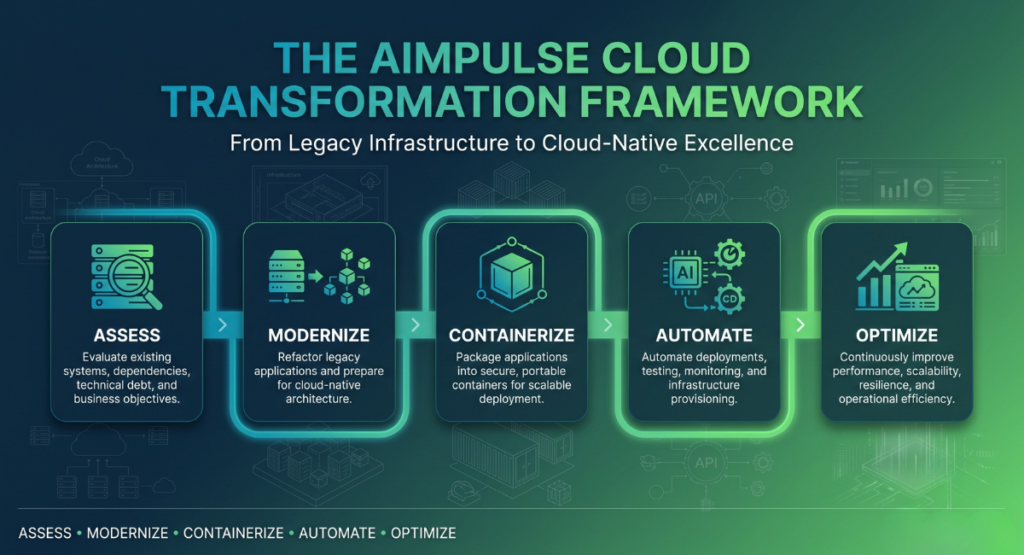
AImpulse guides enterprise architecture teams through a structured five-stage framework for adopting cloud-native architecture safely and incrementally:
- Assess — Audit existing systems, dependencies, and technical debt to identify which components should migrate first.
- Modernize — Refactor monolithic components into well-defined services aligned to business capabilities.
- Containerize — Package services using Docker and prepare them for orchestration with Kubernetes.
- Automate — Build CI/CD pipelines and observability tooling so releases are fast, safe, and measurable.
- Optimize — Continuously tune performance, cost, and scaling policies based on real production data.
Frequently Asked Questions
What is cloud-native architecture? Cloud-native architecture is a design approach that builds applications specifically for cloud environments, using containers, microservices, and automated orchestration. It allows systems to scale elastically and deploy independently, unlike traditional monolithic applications built for fixed, on-premise infrastructure.
Why are legacy systems being replaced? Legacy systems struggle with slow release cycles, rising maintenance costs, and limited scalability. Cloud-native architecture solves these constraints through automation, elasticity, and modular design, while also better supporting European compliance requirements like GDPR and the EU AI Act.
What are the core principles of cloud-native architecture? The core principles include containers, microservices, Kubernetes orchestration, CI/CD automation, observability, and API-first design. Together, these enable systems that are resilient, independently scalable, and faster to update than traditional monolithic infrastructure.
What are the biggest risks in cloud-native migration? The most common risks are “lift and shift” migrations that skip redesign, adopting Kubernetes before the team has DevOps maturity, and neglecting observability. These mistakes often reintroduce legacy-style bottlenecks inside a modern-looking cloud environment.
How can AImpulse help with cloud-native transformation? AImpulse Studio helps enterprises assess existing systems, modernize architecture, and implement containerized, automated cloud-native platforms. Using a structured five-stage framework, AImpulse reduces migration risk while keeping live systems operational throughout the transition.
Conclusion
Cloud-native architecture is no longer an optional upgrade — it’s the foundation modern enterprises need to compete on speed, resilience, and cost efficiency. The organizations succeeding with this shift aren’t rushing to adopt every tool at once; they’re assessing their systems carefully, modernizing incrementally, and building the automation and observability needed to operate confidently at scale.
If your organization is ready to move beyond legacy constraints, learn more about our AImpulse Studio or follow AImpulse on LinkedIn for ongoing insights on cloud-native transformation and enterprise architecture.
Learn More From These Extra Resources
- CNCF — Cloud Native Computing Foundation, cloud-native landscape and standards
- AWS Architecture Center — cloud-native reference architectures
- Microsoft Azure Architecture Center — cloud-native design patterns
- Google Cloud Architecture Center — microservices and Kubernetes best practices