
Introduction
Supply chains are no longer predictable systems.
Demand changes quickly. Transportation costs fluctuate. Suppliers face disruption. Customers expect faster delivery. Businesses are also expected to make decisions using data coming from multiple disconnected systems.
This is where AI in supply chain management is becoming increasingly valuable.
Artificial intelligence helps companies move beyond reactive supply chain management toward intelligent systems that can predict, prioritize, recommend, and automate decisions.
The real opportunity is not simply adding AI tools to logistics operations. Businesses need integrated AI-powered business solutions that connect data, systems, and decisions. It is creating an intelligent supply chain where data from inventory, transportation, warehouses, suppliers, customers, and external signals can work together.
This shift is leading businesses toward a new model:
Supply Chain Visibility → Supply Chain Intelligence → Supply Chain Action
What Is AI in Supply Chain Management?
AI in supply chain management refers to the use of artificial intelligence, machine learning, predictive analytics, computer vision, and related technologies to improve supply chain planning and operations.
Common applications include:
- Demand forecasting
- Inventory optimization
- Route optimization
- Warehouse automation
- Predictive maintenance
- Supplier risk analysis
- Shipment visibility
- Intelligent document processing
- Supply chain risk prediction
AI allows organizations to analyze complex data, identify patterns, and support faster business decisions.
The Real Problem: Supply Chain Data Is Everywhere
Modern supply chains generate huge amounts of data from:
- ERP systems
- Warehouse Management Systems (WMS)
- Transportation Management Systems (TMS)
- CRM platforms
- IoT devices
- GPS tracking
- Suppliers
- Marketplaces
- Customer data
The challenge is that these systems often operate separately.
For example:
A shipment may be delayed.
The transportation system knows about the delay.
The warehouse knows inventory is running low.
The sales team knows an important customer is waiting.
The supplier may have another shipment available.
But without connected intelligence, these signals are difficult to combine quickly.
This is where AI-powered supply chain solutions create value.
7 Ways AI Is Changing Supply Chain Management
1. AI Creates Predictive Supply Chain Visibility
Traditional visibility answers:
What is happening now?
AI helps answer:
What is likely to happen next?
Instead of only tracking shipments, AI analyzes historical and real-time data to identify possible delays, demand changes, capacity problems, and operational risks.
This creates a shift from:
Tracking → Predicting → Acting
For supply chain leaders, visibility becomes more than a dashboard. It becomes a decision-support system.
2. AI Demand Forecasting Reduces Guesswork
Demand forecasting is one of the most practical applications of AI in supply chain management.
Traditional forecasting often depends mainly on previous sales data.
AI can combine multiple signals, including:
- Seasonality
- Promotions
- Market trends
- Customer behavior
- Weather conditions
- Regional demand
- Product performance
- External events
The result is a more dynamic understanding of future demand.
Better forecasting supports better decisions around:
- Inventory
- Purchasing
- Production
- Transportation
Instead of asking:
“How much did we sell last year?”
Businesses can ask:
“What is most likely to happen next?”
3. AI Optimizes Inventory Management
Inventory optimization is not only about reducing stock.
Too much inventory ties up capital.
Too little inventory creates stockouts, delays, and unhappy customers.
AI helps organizations balance these challenges by analyzing:
- Demand patterns
- Lead times
- Supplier reliability
- Product movement
AI can support decisions such as:
- When to reorder
- How much to order
- Where inventory should be located
- Which products need higher safety stock
- Which products are becoming slow-moving
The goal is:
The right inventory, in the right place, at the right time.
4. AI Makes Route Optimization Dynamic
Traditional route planning creates schedules before vehicles leave the warehouse.
Real-world logistics constantly changes.
Traffic changes.
Weather changes.
Customer requirements change.
Vehicles experience delays.
New orders appear.
AI-powered route optimization continuously evaluates these variables and recommends better routes.
This can improve:
- Delivery times
- Vehicle utilization
- Fuel efficiency
- Driver productivity
- Last-mile performance
AI transforms route planning from a fixed schedule into a dynamic decision-making process.
5. AI Turns Warehouses Into Intelligent Operations
Warehouses are becoming a major area for AI adoption.
Computer vision can help identify products and monitor operations.
AI analytics can support:
- Inventory placement
- Picking optimization
- Operational planning
- Predictive maintenance
An intelligent warehouse understands:
What is moving → What is needed → Where it should be stored → When it should be replenished → How it should be delivered
6. AI Predicts Supply Chain Disruptions
Supply chain resilience depends on identifying risks before they become major problems.
AI can analyze different data sources to detect warning signals, including:
- Supplier performance
- Transportation delays
- Weather events
- Market changes
- Capacity limitations
- Route disruptions
The goal is not perfect prediction.
The goal is giving decision-makers more time to respond.
Even a few hours or days of early warning can change available options.
7. AI Creates a Supply Chain Control Tower
An AI supply chain control tower connects information from multiple systems and creates a unified view of supply chain performance.
Instead of separate tools for:
- Inventory
- Transportation
- Warehousing
- Suppliers
- Orders
- Forecasting
Organizations can build an intelligence layer across all operations.
A simplified architecture:
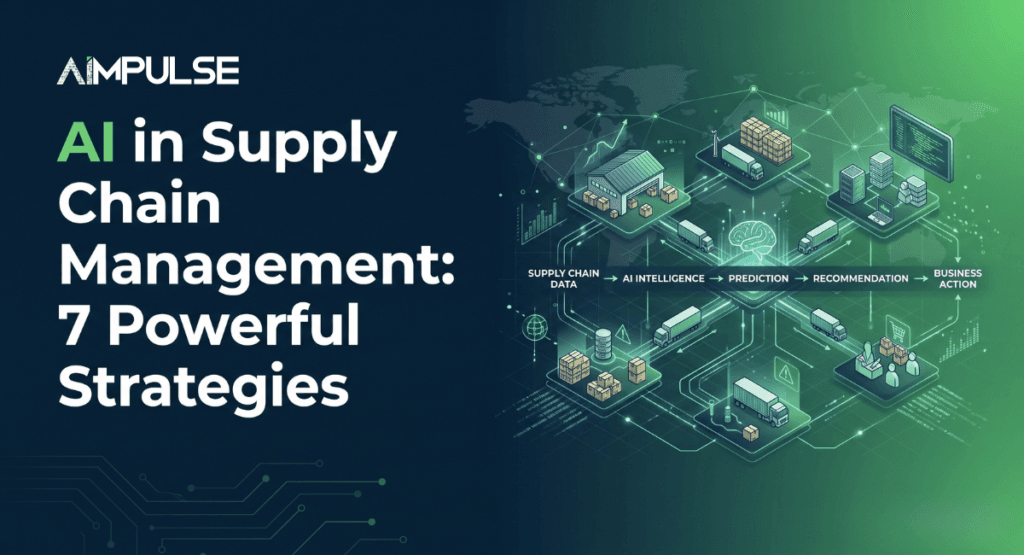
Data Sources → Integration Layer → AI Intelligence → Recommendations → Business Action
AImpulse Supply Chain Intelligence Framework
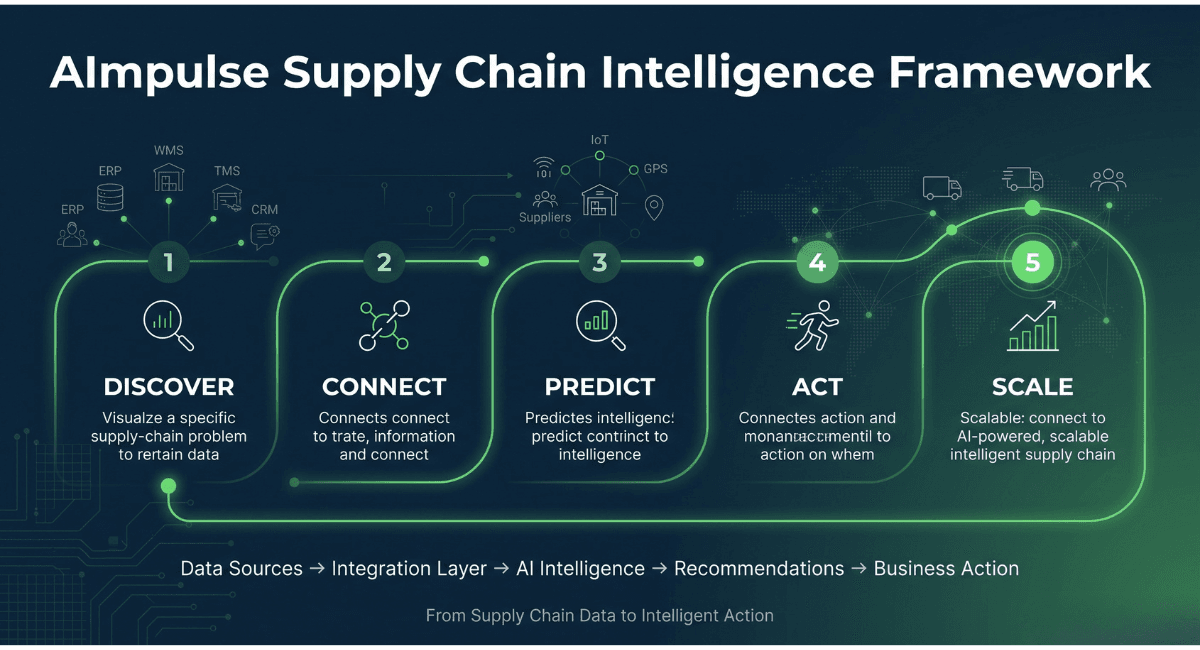
At AImpulse, we view logistics AI as an interconnected technology challenge, not a collection of separate AI features.
Our approach follows five stages:
Discover
Identify the supply chain problem with the highest business impact.
Connect
Integrate operational data and business systems.
Predict
Apply AI and analytics to identify patterns, risks, and opportunities.
Act
Turn intelligence into recommendations, automation, and workflows.
Scale
Continuously improve performance and expand intelligent capabilities.
Common Mistakes When Implementing AI in Supply Chains
Starting With Technology Instead of Business Problems
Not every supply chain challenge requires AI.
Companies should first identify the decision they want to improve.
Building Another Isolated Dashboard
Visibility without action does not create enough value.
Ignoring Integration
AI cannot provide meaningful intelligence if important data remains disconnected.
Automating Decisions Too Early
Some decisions should remain human-supervised until AI reliability is proven.
Measuring AI Activity Instead of Business Outcomes
The real value comes from improvements in:
- Service levels
- Inventory performance
- Delivery efficiency
- Cost reduction
- Supply chain resilience
The Future of AI in Supply Chain Management
The future of logistics will not depend on one AI model.
It will depend on connected intelligence combining:
Predictive AI + Generative AI + Computer Vision + IoT + Cloud + APIs + Automation
Future supply chains will be able to:
- Sense changes
- Understand impacts
- Recommend actions
- Automate responses
The competitive advantage will not come from simply saying:
“We use AI.”
It will come from building supply chains that can:
“See what is happening, understand what it means, and respond faster.”
FAQs About AI in Supply Chain Management
What is AI in supply chain management?
AI in supply chain management uses artificial intelligence and analytics to improve forecasting, inventory, transportation, warehousing, and decision-making.
How is AI used in logistics?
AI is used for demand forecasting, route optimization, inventory management, warehouse operations, predictive maintenance, and disruption detection.
What is an AI supply chain control tower?
It is a connected intelligence layer that combines supply chain data, identifies risks, predicts outcomes, and recommends actions.
How do companies start using AI in supply chain management?
Companies should start with a clear operational problem, evaluate available data, connect systems, choose suitable AI solutions, and measure business results.
Final Thoughts
AI is transforming supply chain management from a reactive function into a predictive and intelligent operating system.
Successful AI adoption is not only about implementing new technology.
It is about connecting:
Data + Systems + Intelligence + Action
AImpulse helps businesses design and build AI-powered supply chain solutions, from intelligent forecasting and optimization to integrated enterprise platforms.