
Building an AI product is not simply about adding an AI model to an existing application.
The difficult part begins after the first successful prototype.
A production-ready AI product needs reliable software architecture, secure data flows, scalable infrastructure, well-designed APIs, continuous testing, and a product experience that solves a real business problem.
This is where AI Product Engineering becomes critical.
AI product engineering brings together product thinking, software engineering, AI capabilities, cloud infrastructure, security, and continuous improvement to turn an AI concept into a reliable product.
For startups, this can mean moving from an AI MVP to a scalable SaaS product. For enterprises, it can mean integrating AI into existing systems without creating another isolated technology layer.
The goal is not simply to build AI.
The goal is to engineer a product that uses AI effectively.
Table of Contents
- What Is AI Product Engineering?
- Why AI Products Require a Different Engineering Approach
- 7 Principles of Effective AI Product Engineering
- From AI MVP to Production
- Common Engineering Mistakes
- How AImpulse Approaches AI Product Engineering
- FAQs
What Is AI Product Engineering?
AI product engineering is the process of designing, developing, deploying, and continuously improving software products that use artificial intelligence as part of their core functionality.
Unlike traditional software, AI products often depend on additional components such as:
- Machine learning or generative AI models
- Data pipelines
- Model APIs
- Vector databases
- AI agents
- Evaluation systems
- Prompt and context management
- Monitoring and observability
- Human-in-the-loop workflows
This creates additional engineering challenges.
An AI feature might work perfectly in a controlled demonstration but behave unpredictably when exposed to thousands of real users.
That means engineering decisions need to account for performance, reliability, security, cost, data quality, and model behavior from the beginning.
Why AI Products Require a Different Engineering Approach
Traditional applications generally follow deterministic logic:
Input → Processing → Output
AI systems can introduce probabilistic behavior:
Input → Context + Model → Generated Output
The same input may not always produce exactly the same result.
This changes how products need to be engineered and tested.
For example, an AI customer-support platform cannot be evaluated only by asking whether the application is online.
The engineering team also needs to ask:
- Is the AI response accurate?
- Is sensitive information protected?
- Can the system handle increased traffic?
- How much does each interaction cost?
- What happens when the AI produces an incorrect response?
- Can developers monitor model performance?
- Can the AI component be replaced if a better model becomes available?
These questions make AI product engineering a multidisciplinary challenge.
7 Principles of Effective AI Product Engineering
1. Start With the Product Problem
The first engineering decision should not be which AI model to use.
It should be:
What problem are we solving?
A technically impressive AI system can still fail if customers do not need it.
Before development begins, define:
- The target user
- The business problem
- The desired outcome
- The core workflow
- The success metrics
- Where AI actually adds value
This keeps engineering connected to product strategy rather than technology for its own sake.
2. Design the Architecture Around AI From the Beginning
AI should not always be treated as a plugin added to an existing application.
The architecture may need dedicated components for data processing, model interaction, context management, evaluation, monitoring, and security.
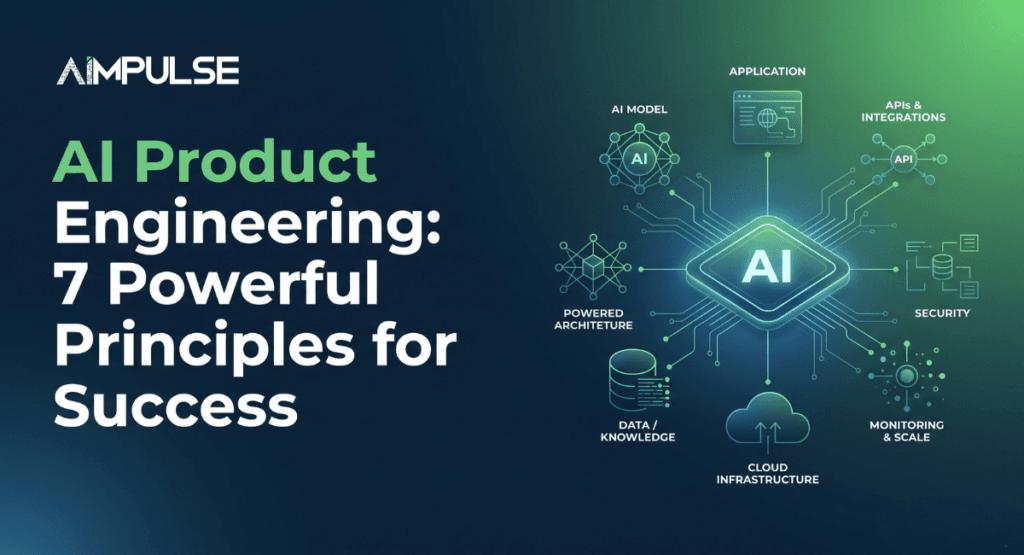
A typical AI product architecture might look like:
User Interface → Application Layer → AI Orchestration → Model → Data / Knowledge Layer
The surrounding infrastructure then handles authentication, APIs, databases, monitoring, logging, and deployment.
This approach makes the AI component easier to control, test, replace, and scale.
3. Build for Security From Day One
Security should not be added after the AI feature is finished.
This is particularly important when an AI product processes customer data, internal documents, business information, or personal information.
Engineering teams should consider:
- Authentication and authorization
- Encryption
- Data isolation
- API security
- Secrets management
- Access controls
- Logging and monitoring
- Secure development practices
- Model and prompt security
Security needs to be integrated throughout planning, development, testing, deployment, and maintenance.
4. Treat APIs and Integrations as Core Product Infrastructure
Most enterprise AI products do not operate independently.
They need to communicate with existing systems such as:
- CRMs
- ERPs
- Payment platforms
- E-commerce systems
- Internal databases
- Authentication platforms
- Logistics systems
A well-designed integration layer allows AI capabilities to interact with existing business processes without forcing companies to rebuild their entire technology stack.
The AI becomes valuable because it is connected to business systems, not because the model exists by itself.
5. Engineer for Evaluation, Not Just Testing
Traditional software testing asks:
Does the system behave according to the expected logic?
AI systems require another layer of evaluation:
Is the AI output useful, accurate, safe, and consistent enough for the intended use case?
AI product engineering should establish measurable evaluation criteria, including:
- Accuracy
- Relevance
- Hallucination rate
- Response time
- Task completion
- User satisfaction
- Cost per interaction
- Safety compliance
Evaluation should continue after launch because real-world usage reveals problems that may not appear during development.
6. Design for Scale and Cost
An AI prototype can be inexpensive to operate.
A successful product with thousands or millions of interactions can be completely different.
Engineering teams need to consider:
- Model selection
- Caching
- Request optimization
- Infrastructure scaling
- Database architecture
- Asynchronous processing
- API limits
- Observability
- Cost monitoring
Sometimes the most powerful model is not the best product decision.
A smaller, faster, and less expensive model may deliver the required business outcome more effectively.
7. Build for Continuous Improvement
AI products should not be considered finished when they are deployed.
Models change. User behavior changes. Data changes. Business requirements change.
The product needs an engineering feedback loop:
Build → Deploy → Measure → Learn → Improve
This requires:
- Monitoring
- Analytics
- User feedback
- Model evaluation
- Regular improvements
Continuous improvement reduces risk and helps companies build AI products that remain valuable over time.
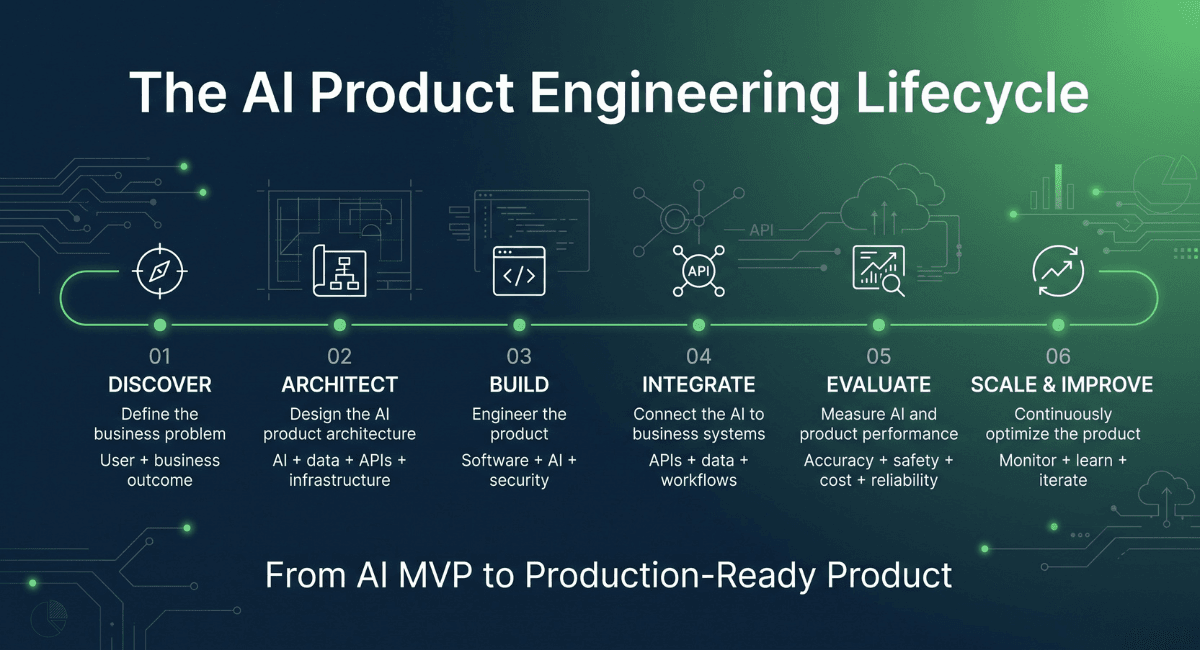
From AI MVP to Production
One of the biggest mistakes companies make is assuming that a successful MVP is almost finished.
Usually, it is only the beginning.
Production engineering proves that the product can work reliably, securely, and economically at scale.
The transition requires strengthening:
MVP
- Basic AI integration
- Limited users
- Manual monitoring
- Prototype security
- Basic prompts
Production
- Robust AI architecture
- Scalable infrastructure
- Automated observability
- Security-by-design
- Managed AI orchestration
Common AI Product Engineering Mistakes
Building around the model instead of the customer
Choosing the latest AI model does not automatically create a valuable product.
Ignoring architecture until later
Technical debt becomes expensive when the product is already serving customers.
Treating AI as a black box
Without monitoring and evaluation, teams may not know when performance decreases.
Underestimating integration complexity
Connecting AI to real business systems often requires significant engineering effort.
Forgetting unit economics
An AI feature that loses money with every interaction is not sustainable.
How AImpulse Approaches AI Product Engineering
At AImpulse, we approach AI product development as an engineering and product challenge, not simply an AI implementation exercise.
Our approach connects:
Product Strategy → Architecture → AI → Engineering → Security → Cloud → Integration → Scale
The objective is to create products that are technically sound while remaining aligned with business objectives.
Whether the requirement is an AI-powered SaaS product, enterprise AI platform, intelligent workflow, or AI capability integrated into an existing system, the engineering approach should start with the business problem and work backward.
The result is not just an AI feature.
It is a product engineered to create measurable value.
FAQs
What is AI product engineering?
AI product engineering is the process of designing, developing, deploying, and improving software products that use AI as a core part of their functionality.
How is AI product engineering different from traditional software development?
AI products introduce additional challenges around model behavior, data, evaluation, AI security, infrastructure, cost, and continuous monitoring.
Should AI be included in the architecture from the beginning?
Yes. Designing architecture around AI requirements can reduce technical debt and improve scalability.
How do you move an AI MVP into production?
The transition requires stronger architecture, security, testing, AI evaluation, monitoring, infrastructure, integrations, and cost controls.
Is AI product engineering only for startups?
No. Enterprises can use AI product engineering to build new AI products or integrate AI into existing systems.
Build AI That Works Beyond the Demo
The next generation of software will not simply use AI.
It will be engineered around AI.
Companies that want to turn AI ideas into reliable products need more than a model and a prototype.
They need product thinking, engineering discipline, secure architecture, integration capabilities, and a clear path to scale.
That is the difference between demonstrating AI and building an AI product.
Ready to turn an AI idea into a production-ready product?
Explore AImpulse AI Product Development or connect with the AImpulse team to discuss your product.