

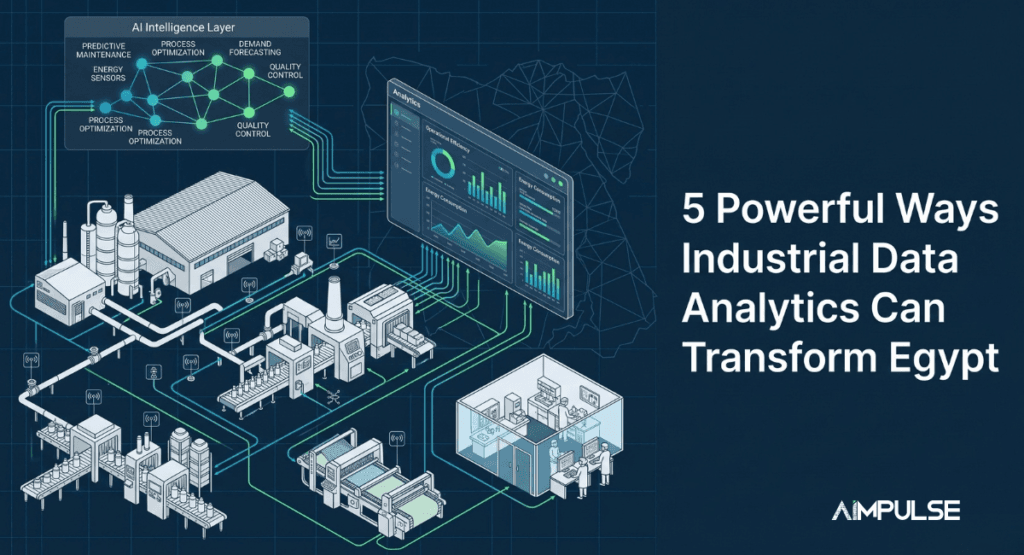
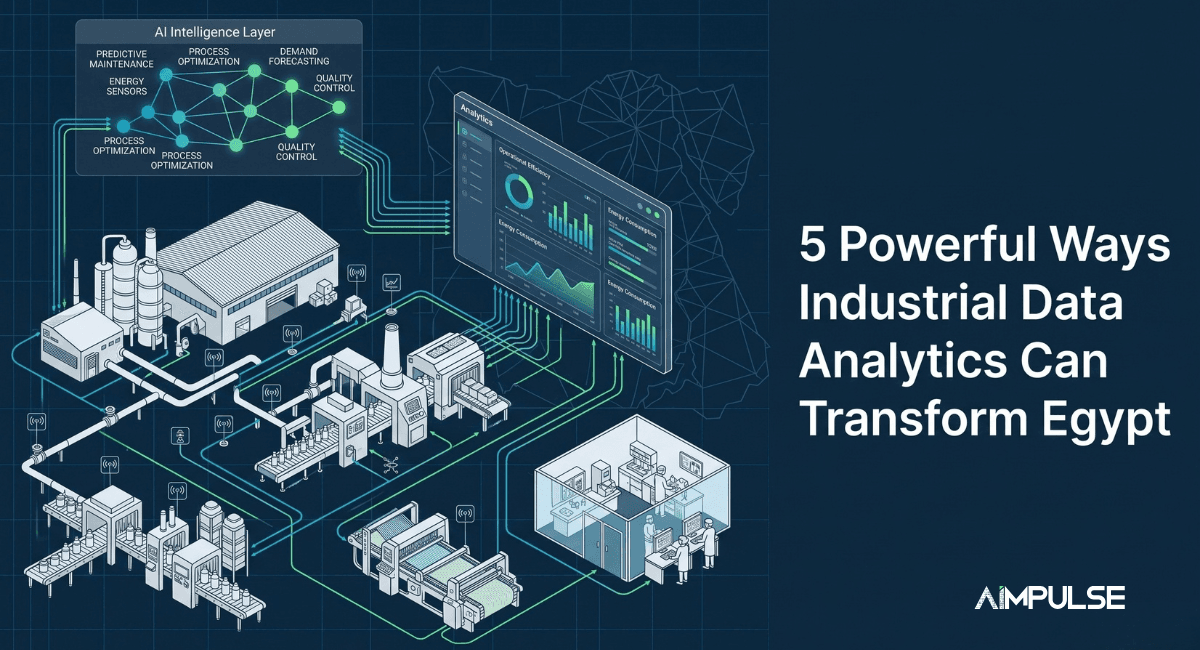
5 Powerful Ways Industrial Data Analytics Can Transform Egypt
Industrial data analytics Egypt is becoming increasingly relevant as manufacturers look for practical ways to improve efficiency, strengthen competitiveness and prepare their operations for artificial intelligence.
Egypt is entering an important period of industrial expansion and modernisation.
The National Industrial Strategy 2026–2030 aims to increase non-oil exports to $100 billion by 2030 while strengthening local manufacturing, supplier development and Egypt’s position in global value chains. SIS
At the same time, Egypt’s National Artificial Intelligence Strategy 2025–2030 identifies sectoral efficiency, data accessibility and scalable AI infrastructure as important national priorities. ai.gov.eg
Together, these ambitions create an important question for manufacturers:
Before investing in more technology, how much value can be extracted from the systems and data already operating inside the factory?
For many organisations, the first step toward industrial AI may not be buying another platform.
It may be learning to understand the data they already generate.
What Is Industrial Data Analytics?
Industrial data analytics is the process of collecting, interpreting and analysing information generated by machines, sensors, production systems and operational processes.
For manufacturers, that data may include:
- Machine measurements
- Production records
- Equipment alarms
- Energy consumption
- Quality measurements
- Maintenance history
- ERP data
- Inventory and supply-chain records
The objective is straightforward:
Turn operational data into information that people can use to make better decisions.
The challenge is that industrial data is rarely created specifically for modern analytics.
A control system may have been installed years ago.
The equipment may still be collecting valuable information every day.
But nobody may have revisited how that information is structured, retained, connected or analysed.
That creates an important opportunity.
Existing industrial systems may already contain years of operational knowledge.
Why Industrial Data Analytics Egypt Matters Now
For manufacturers, industrial data analytics Egypt provides a practical way to connect existing operational data with measurable business improvement.
Egypt’s industrial strategy places strong emphasis on local manufacturing, competitiveness, exports and deeper integration into global value chains.
Priority industries include ready-made garments, textiles, food industries, pharmaceuticals, automotive manufacturing, electrical and engineering equipment, and electronics. SIS
Across these sectors, better use of data can support operational improvement without requiring every factory to replace its existing technology infrastructure.
The commercial question is therefore not simply:
“How can we introduce AI?”
A better question is:
“Where can better use of existing data improve the economics of what we already operate?”
That distinction matters.
Technology should solve a measurable operational problem.
Not create another layer of complexity.
5 Ways Industrial Data Analytics Can Create Value
1. Turn Existing Machine Data Into Operational Intelligence
Industrial equipment can generate enormous amounts of information.
Yet management teams may see only a small fraction of it.
A daily report might contain twenty measurements while the underlying production or control system stores hundreds or thousands of data points.
This creates a gap between:
Data collected
and
Data actually used.
Global research commissioned by Seagate and conducted by IDC found that only 32% of enterprise data available to organisations was being put to work, while 68% remained unleveraged. The research is not specific to Egypt, but it illustrates a broader data-utilisation challenge that industrial organisations should consider. seagate.com
The exact percentage will vary from one factory to another.
The underlying principle does not.
Having data is not the same as using data.
An Egyptian manufacturer may already have years of:
- Temperature readings
- Pressure values
- Alarm history
- Production quantities
- Downtime records
- Energy measurements
- Quality information
The first opportunity is therefore often not collecting more data.
It is understanding what already exists.
Once technical records are translated into operational meaning, historical machine data can become a source of operational intelligence.
2. Establish a Reliable Operational Baseline
Before asking AI to predict a failure, manufacturers need to understand normal behaviour.
Consider a machine temperature of 80°C.
That number means very little by itself.
It may be completely normal during one production stage and highly unusual during another.
Context changes the interpretation.
A useful baseline can help answer questions such as:
- What does normal equipment temperature look like?
- What is the typical alarm frequency?
- How does production change between shifts?
- What happens during startup and shutdown?
- Which measurements normally move together?
- How does equipment behave under different production loads?
Once normal behaviour has been established, analytics can begin identifying meaningful deviations.
That creates a stronger foundation for anomaly detection.
Where sufficient historical failure and maintenance records exist, it may eventually support predictive maintenance as well.
But the order matters:
Baseline first. Prediction later.
3. Separate Real Operational Problems From Data Noise
Industrial systems can generate large volumes of alarms and events.
High volume can create urgency.
But volume alone does not always tell you how serious a problem is.
Imagine a factory records:
1,000 alarm events.
If 900 of those events come from one malfunctioning sensor, the problem may be highly concentrated.
Now imagine 1,000 events originating from 180 different machines and instruments.
The event count is identical.
The operational meaning is completely different.
This is why industrial data analytics Egypt projects should analyse both:
Volume: How many events occurred?
and
Breadth: How many independent assets generated them?
That distinction helps engineering teams understand whether they are looking at:
- One noisy instrument
- One failing machine
- One unstable production area
- Or a wider operational issue
Good analytics should reduce noise.
Not create more dashboards filled with it.
4. Improve Energy and Resource Visibility
Energy efficiency has direct implications for industrial competitiveness.
Egypt is also expanding renewable-energy use within the industrial sector.
The government’s Sun of Industry initiative aims to install solar-power stations on the rooftops of around 7,000 factories across different governorates. SIS
But installing new energy infrastructure is only one part of the challenge.
Manufacturers also need to understand how energy is actually being consumed.
Useful questions include:
- When is energy consumption highest?
- Which machines consume the most energy?
- How does consumption change with production volume?
- What happens during idle periods?
- Where does abnormal consumption occur?
- How does actual demand compare with expected demand?
Existing meter, machine and production data can provide a foundation for this analysis.
The goal is not simply to produce an energy dashboard.
The goal is to connect energy use with operational behaviour.
For example:
Energy consumption + production volume + machine state
can provide more useful information than energy consumption alone.
This is where manufacturing analytics becomes commercially useful.
This makes industrial data analytics Egypt particularly relevant for manufacturers seeking better energy visibility and stronger operational efficiency.
5. Build a Practical AI Foundation Without Overspending
AI initiatives can become expensive when organisations begin with infrastructure instead of evidence.
A factory may be encouraged to invest immediately in:
- New platforms
- New sensors
- Cloud infrastructure
- AI software
- Data lakes
- Predictive models
Some of those technologies may eventually be valuable.
But the organisation should first establish whether the existing evidence supports the investment.
A more practical sequence is:
Read the data.
Identify one measurable problem.
Establish normal behaviour.
Test one analytical hypothesis.
Verify the result.
Then decide what technology is justified.
This approach is especially important where capital expenditure, imported technology and foreign-currency costs need to be carefully managed.
For organisations assessing industrial data analytics Egypt opportunities, starting with the evidence can reduce unnecessary infrastructure spending while creating a clearer business case for future investment.
When an analytical capability moves from a pilot into a production system, AI product engineering also becomes important because data pipelines, architecture, security, monitoring and scalability need to work reliably together.
Industrial Data Across Key Egyptian Industries
Different industries create different types of operational data.
The analytical opportunity therefore depends on the production environment.
Food Manufacturing
Production, temperature, quality and cold-chain records can support:
- Traceability
- Quality analysis
- Production monitoring
- Energy analysis
- Waste reduction
- Maintenance planning
For food manufacturers competing in export markets, consistent process visibility can become increasingly important.
Pharmaceuticals
Pharmaceutical manufacturing operates with extensive documentation, process controls and batch records.
That structured information can create opportunities for advanced analytics around:
- Batch performance
- Equipment behaviour
- Process consistency
- Quality trends
- Operational deviations
The goal is not to replace validated processes with AI.
It is to determine where analytics can support better operational understanding.
Textiles and Garments
Manufacturing analytics can reveal:
- Production delays
- Changeover time
- Machine utilisation
- Rework
- Quality issues
- Energy consumption
- Production differences between shifts
These insights can support productivity and export competitiveness.
Automotive and Components
Automotive manufacturing depends heavily on consistency, suppliers and quality.
Production and quality data can help manufacturers understand process performance and demonstrate capability to larger OEM customers.
For organisations dealing with complex suppliers and logistics, AI in supply chain management can also connect factory data with inventory, procurement and delivery information.
Building Materials
Cement, glass, ceramics and other energy-intensive operations generate significant process and equipment data.
Analysis can reveal operational patterns that are not always visible in traditional management reports.
This can support areas such as:
- Energy visibility
- Equipment comparison
- Production stability
- Maintenance analysis
- Process optimisation
A Practical Starting Point for Egyptian Manufacturers
Industrial digital transformation does not need to begin with a large transformation programme.
A factory can begin with one measurable operational question.
Step 1: Find the Data
Identify what the factory already records.
Look across:
- Control systems
- Machine files
- Historians
- ERP platforms
- Maintenance systems
- Energy meters
- Quality records
- Production reports
Step 2: Open the Actual Data
Do not rely only on documentation.
Documentation describes what a system is supposed to contain.
The data shows what it actually contains.
Step 3: Resolve the Technical Vocabulary
Understand what tags, codes, measurements and events represent.
Technical identifiers need to be connected to real equipment and operational meaning.
Step 4: Establish Normal Behaviour
Build a reliable baseline before searching for abnormalities.
Step 5: Test One Business Question
For example:
“Can we identify the conditions that appear before abnormal machine behaviour?”
or:
“Can we explain why energy consumption increased without a corresponding increase in production?”
One clear question creates a much stronger analytical project than a broad request to:
“Use AI in the factory.”
Step 6: Decide What Comes Next
The evidence may justify:
- A dashboard
- Data engineering
- An anomaly-detection system
- Energy analytics
- Predictive maintenance
- System integration
- A broader industrial AI project
The technology should follow the evidence.
The AImpulse Data-to-AI Framework
At AImpulse, we use a simple principle:
Data Before Architecture.
Our Data-to-AI approach follows five stages:
READ
Understand the actual data.
Start with the files, systems and historical records that already exist.
RESOLVE
Translate technical records into operational meaning.
Connect tags, measurements and events to real machines and processes.
BASELINE
Understand what normal looks like.
Establish a trustworthy reference before searching for anomalies.
ANALYSE
Find patterns, anomalies and opportunities.
Test specific operational questions against the evidence.
VERIFY
Check important findings against the source data.
The result should be reproducible and understandable.
Only after these steps do we determine whether the right next step is:
- Industrial analytics
- Anomaly detection
- Automation
- AI
- Additional data engineering
- New infrastructure
This prevents an expensive mistake:
Building sophisticated technology around assumptions the data cannot support.
Why Local Analytical Capability Matters
Digital transformation should build capability.
Not permanent dependency.
A dashboard that only an external provider can understand may simply create another operational dependency.
An analytical method that Egyptian engineers can understand, verify and reproduce creates internal capability.
This matters for a country focused on strengthening local manufacturing, technology transfer and participation in global value chains.
The objective should be to leave the organisation with more knowledge than it had before the project began.
That requires:
- Clear data ownership
- Transparent analytical methods
- Documentation
- Internal technical involvement
- Reproducible findings
- Measurable business outcomes
What Industrial Data Cannot Do
Industrial data has limits.
AI cannot recover information that was never recorded.
Predictive maintenance is a good example.
A reliable failure-prediction model normally requires meaningful historical examples of:
- Failures
- Maintenance activity
- Operating conditions
- Events leading up to failure
If those records do not exist, promising precise failure prediction would be difficult to justify.
A more practical roadmap may be:
Anomaly detection now → better data collection → predictive capability later.
That is not a failed AI project.
It is a more responsible one.
Frequently Asked Questions
What is industrial data analytics?
Industrial data analytics is the analysis of information generated by machines, sensors, production systems and industrial processes to improve operational decision-making.
How can Egyptian factories use industrial data?
Factories can use industrial data to understand equipment performance, production efficiency, energy consumption, quality, maintenance requirements and unusual operational behaviour.
Can old factory equipment be used for analytics?
Often, yes.
The first step is determining what information existing systems generate, whether it can be accessed and whether the technical records can be correctly interpreted.
Replacing equipment should not automatically be the first decision.
Does industrial AI require replacing existing systems?
Not necessarily.
Existing machines, control systems and business platforms may already contain valuable information.
Where older technology limits access or integration, legacy system modernisation may become part of the roadmap rather than the starting assumption.
Should every factory start with predictive AI?
No.
The correct starting point depends on the quality, history and completeness of the available data.
Some manufacturers may gain more immediate value from basic analytics, operational baselines or anomaly detection.
How does industrial data support AI?
AI systems depend on reliable evidence.
Better-organised and better-understood industrial data creates a stronger foundation for machine learning, anomaly detection, optimisation and other AI applications.
How AImpulse Helps
AImpulse helps manufacturers understand what their existing data can support before committing to larger technology investments.
For companies exploring industrial data analytics Egypt, the first step is understanding what their existing systems and historical data can realistically support.
Our work can include:
- Industrial data analysis
- AI-readiness assessments
- Operational intelligence
- Anomaly detection
- Data engineering
- AI strategy
- Integration planning
- Custom AI development
When a broader system is required, our AI-powered business solutions approach connects data, software engineering, AI, security and scalable architecture around a defined business problem.
The objective is not to introduce technology for its own sake.
It is to identify where technology can create measurable operational value.
For manufacturers exploring industrial data analytics Egypt, a practical first engagement can be an assessment of existing operational data.
The assessment can answer questions such as:
What data already exists?
What can it reliably tell us?
Where is the highest-value analytical opportunity?
What should we build next—and what do we not need to build yet?
That creates a clearer path from factory data to investment decisions.
Conclusion
Egypt’s industrial strategy is focused on stronger manufacturing, competitiveness, exports, localisation and integration into global value chains.
Artificial intelligence can contribute to that transformation.
But the strongest starting point may be much simpler than another AI platform.
Look at the data you already have.
It may contain years of operational knowledge that nobody has fully extracted.
Read it.
Understand it.
Establish what normal looks like.
Analyse it.
Verify it.
Then build.
That is how industrial data analytics Egypt can become a practical foundation for smarter and more competitive Egyptian manufacturing.