

Agentic AI: 7 Powerful Shifts Shaping Business in 2026
For the past few years, businesses have been asking:
“How can we use AI?”
In 2026, a more important question is emerging:
“What work can AI actually do?”
That distinction matters.
Generative AI changed how people create, search, summarize, analyze, and communicate. The next evolution is agentic AI—systems that can move beyond generating an answer and begin planning tasks, using tools, interacting with software, and taking actions toward a defined goal.
This does not mean businesses are suddenly handing everything over to autonomous machines.
In fact, the most important development may be more practical:
AI is moving from a tool employees use to an intelligence layer embedded inside business workflows.
Stanford‘s 2026 AI Index reports that organizational AI adoption reached 88% among surveyed organizations, while deployment of AI agents remains comparatively early.
That gap represents the next major opportunity.
Table of Contents
- What Is Agentic AI?
- 7 Powerful Shifts Agentic AI Is Creating
- What Businesses Should Do Now
- The AImpulse Perspective
- What Comes After Generative AI?
- FAQs About Agentic AI
- Final Thought
What Is Agentic AI?
Agentic AI refers to AI systems designed to pursue goals through multiple steps rather than simply responding to a single prompt.
A traditional AI interaction might look like:
Human → Prompt → AI → Answer
An agentic workflow can look more like:
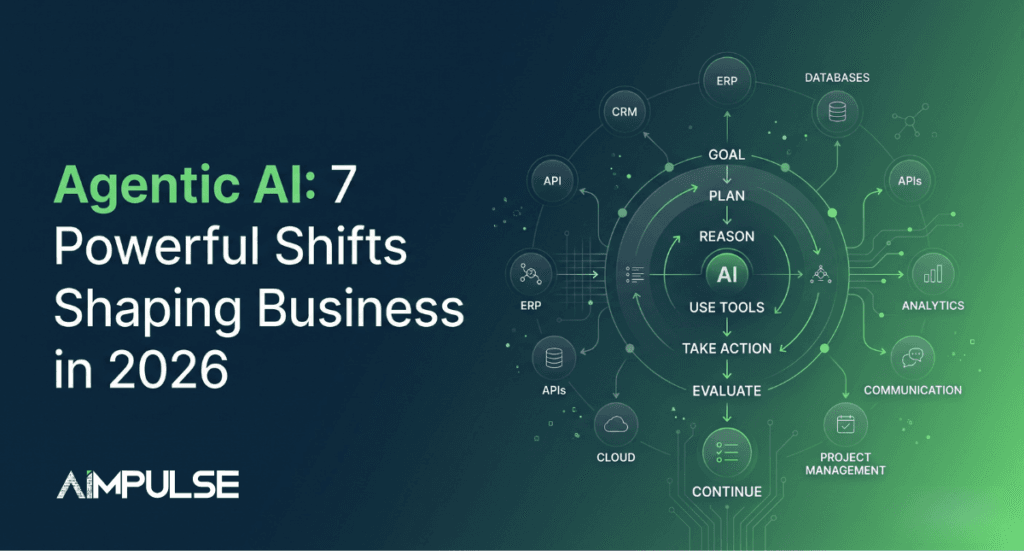
Goal → Plan → Reason → Use Tools → Take Action → Evaluate → Continue
For example, imagine asking an AI system:
“Find the delayed customer orders, identify the cause, prioritize them, and prepare the recommended next actions.”
A traditional chatbot might provide a summary.
An AI agent could potentially:
- Access the order management system.
- Identify delayed orders.
- Check logistics information.
- Analyze the causes.
- Prioritize high-risk orders.
- Prepare recommendations.
- Trigger approved workflows.
The difference is not simply intelligence.
It is agency.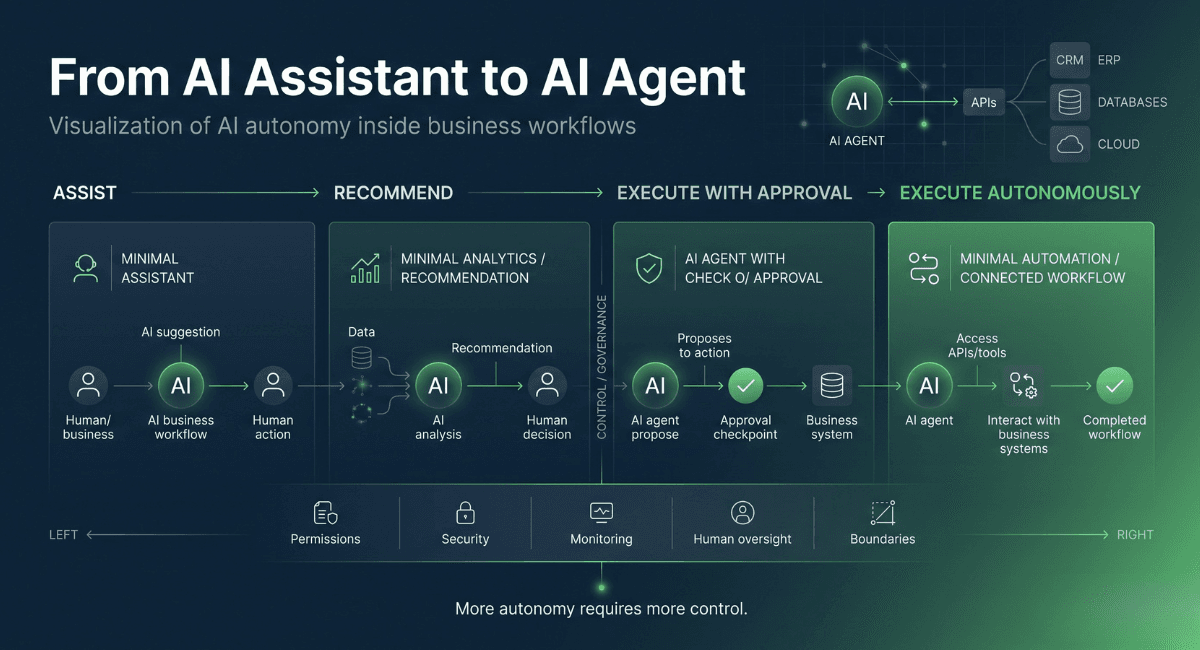
Gartner’s 2026 research describes agentic AI as a rapidly evolving field but also highlights a significant gap between adoption expectations and current deployment.
7 Powerful Shifts Agentic AI Is Creating
1. AI Is Moving From Assistant to Operator
The first generation of business AI primarily helped employees perform tasks faster.
Write an email.
Summarize a document.
Generate a report.
Analyze some data.
Agentic AI introduces another possibility:
Let the AI execute parts of the workflow.
For example, an AI system could monitor incoming customer requests, classify them, retrieve relevant information, draft a response, update a CRM record, and escalate exceptions.
Humans remain involved where judgment or approval is important.
This creates a new model:
Human + AI Agent + Business Systems
Rather than replacing the employee, the agent becomes another operational layer.
2. The AI Interface Is Changing
For decades, software has been built around interfaces.
Users open applications.
They navigate menus.
They enter information.
They click buttons.
AI agents challenge this model.
Instead of requiring employees to understand how every system works, they can increasingly express an objective in natural language.
For example:
“Prepare this month’s sales performance report and identify the three accounts that require attention.”
The system can potentially determine which information it needs, retrieve it from different systems, analyze it, and return the result.
This does not mean traditional interfaces disappear.
It means natural language becomes another interface to enterprise software.
3. SaaS Is Becoming an AI-Orchestrated Ecosystem
One of the most interesting consequences of agentic AI is what happens to SaaS.
Businesses historically bought software applications and employees used them directly.
With AI agents, the relationship can change.
An employee may interact primarily with an AI layer while the agent works across:
CRM → ERP → HR → Analytics → Communication → Project Management
The individual applications still exist.
But the agent becomes the coordinator.
This makes API integration, permissions, data architecture, and interoperability increasingly important.
The future enterprise stack may therefore look less like a collection of applications and more like a network of connected capabilities that intelligent systems can orchestrate.
4. AI-Native Businesses Will Be Designed Differently
There is a difference between:
AI-enabled
and
AI-native.
An AI-enabled company adds AI to existing processes.
An AI-native company asks a different question:
“If we were designing this business today with AI available from day one, how would the operation work?”
That could change:
- Customer service
- Sales
- Product development
- Internal operations
- Software development
- Supply chain management
- Decision-making
- Business intelligence
Gartner has described the movement toward an AI-first operating model in which AI becomes a consideration across business decisions, workflows, and investments.
The strategic opportunity is therefore bigger than automation.
It is business redesign.
5. AI Agents Will Increase the Importance of Governance
More autonomy creates more responsibility.
An AI agent that only generates text has limited ability to affect the outside world.
An agent that can:
- Send emails
- Access customer records
- Modify databases
- Create transactions
- Call APIs
- Approve workflows
has significantly more power.
That means businesses need to establish boundaries.
Important questions include:
What can the agent access?
Only the data required for its task.
What can it change?
Not every action should be autonomous.
When is human approval required?
High-impact actions may require explicit authorization.
How are actions monitored?
Businesses need visibility into what agents are doing and why.
What happens when something goes wrong?
There should be clear rollback, escalation, and intervention mechanisms.
This is why AI governance, cybersecurity, identity, observability, and secure software engineering are becoming increasingly important alongside agentic AI.
Stanford’s 2026 AI Index also highlights a widening gap between AI capabilities and the frameworks needed to govern and understand them.
6. AI Engineering Is Becoming a Strategic Capability
The AI conversation used to focus heavily on models.
Which model?
How large?
How intelligent?
What benchmark score?
Those questions still matter.
But businesses increasingly need to think about the system surrounding the model.
A production AI system may require:
Data + Models + APIs + Cloud + Security + Evaluation + Monitoring + Business Logic
This means AI adoption is becoming an engineering challenge.
Companies that want reliable AI products need strong architecture, integration, security, and product development—not simply access to a powerful model.
McKinsey’s 2026 research reflects this transition, finding that leading organizations are increasingly scaling agentic AI and using AI coding tools to build software internally.
The competitive advantage may therefore shift from:
Who has access to AI?
to:
Who can engineer AI effectively into their business?
7. AI ROI Will Become More Important Than AI Adoption
There was a period when simply using AI could be considered innovation.
That is changing.
Businesses are now asking harder questions:
- How much does this AI system cost?
- How much time does it save?
- Does it increase revenue?
- Does it reduce operational costs?
- Does it improve customer experience?
- Does it reduce errors?
- Can the result be measured?
Gartner forecasts worldwide AI spending of $2.59 trillion in 2026, representing a 47% increase from the previous year.
But increasing investment does not automatically mean increasing value.
The companies that benefit most will likely be those that connect AI initiatives to measurable business outcomes.
AI adoption is not the KPI.
Business impact is.
What Businesses Should Do Now
Companies do not need to transform their entire organization overnight.
A more practical approach is to identify workflows where AI can create measurable value.
Step 1: Find repetitive, high-value workflows
Look for processes involving large amounts of information, repetitive decisions, or frequent manual coordination.
Step 2: Map the systems involved
Identify the CRM, ERP, databases, APIs, documents, and other systems the workflow depends on.
Step 3: Decide the appropriate level of autonomy
Not every process should be fully autonomous.
A useful progression is:
Assist → Recommend → Execute With Approval → Execute Autonomously
Step 4: Build the right architecture
Consider APIs, permissions, data access, security, observability, and failure handling before deployment.
Step 5: Measure business outcomes
Track time saved, cost reduction, accuracy, revenue impact, customer experience, or another meaningful business metric.
The AImpulse Perspective
At AImpulse, we believe the future of AI is not about putting a chatbot on every website.
It is about building intelligent systems that understand business context and can work across the technology ecosystem surrounding an organization.
The opportunity sits at the intersection of:
AI + Product Engineering + APIs + Cloud + Data + Security + Business Strategy
That is why the next generation of AI solutions will increasingly look less like standalone applications and more like intelligent operating layers.
An AI agent should not exist simply because agents are trending.
It should exist because it can make a business process:
faster, smarter, more scalable, or more valuable.
Our approach is therefore simple:
Identify the business problem → Design the intelligence → Connect the systems → Engineer the solution → Measure the impact → Scale what works.
What Comes After Generative AI?
The next phase of AI will not eliminate generative AI.
It will build on it.
Generative AI gives systems the ability to create and reason over information.
Agentic AI adds the ability to pursue objectives through actions and workflows.
Together, they create a fundamentally different possibility for software.
Software that does not simply wait for instructions.
Software that can understand goals, coordinate information, interact with systems, and help move work forward.
The biggest opportunity in 2026 is therefore not asking:
“What can AI generate?”
It is asking:
“What can AI accomplish?”
That is the question businesses should be designing for now.
FAQs About Agentic AI
What is agentic AI?
Agentic AI refers to AI systems that can pursue goals through multiple steps, including planning, reasoning, using tools, and taking actions within defined boundaries.
What is the difference between generative AI and agentic AI?
Generative AI primarily creates content or responses from user input. Agentic AI extends this capability by allowing systems to plan and execute multi-step tasks toward a goal.
How are AI agents used in business?
AI agents can support customer service, software development, research, operations, sales, data analysis, workflow automation, supply chain management, and other business processes.
Are AI agents fully autonomous?
Not necessarily. Businesses can define different levels of autonomy, from AI recommendations requiring human approval to systems capable of executing predefined actions independently.
Is agentic AI the future of enterprise software?
Agentic AI is likely to become an important layer of enterprise software, particularly where systems need to coordinate information and actions across multiple applications. However, successful adoption will depend on architecture, governance, security, data quality, and measurable business value.
How can companies prepare for agentic AI?
Companies should begin by identifying valuable workflows, improving data and API infrastructure, defining security and governance requirements, and experimenting with controlled AI automation before expanding autonomy.
Final Thought
The AI race is entering a different phase.
The question is no longer simply who has the smartest model.
It is increasingly about who can turn intelligence into reliable action.
The companies that win the next phase of AI will not necessarily be the ones using the most AI.
They will be the ones that know where AI belongs, what it should be allowed to do, and how to turn it into measurable business value.
AI is becoming an operating layer.
The opportunity is to build the business around it—intentionally.