

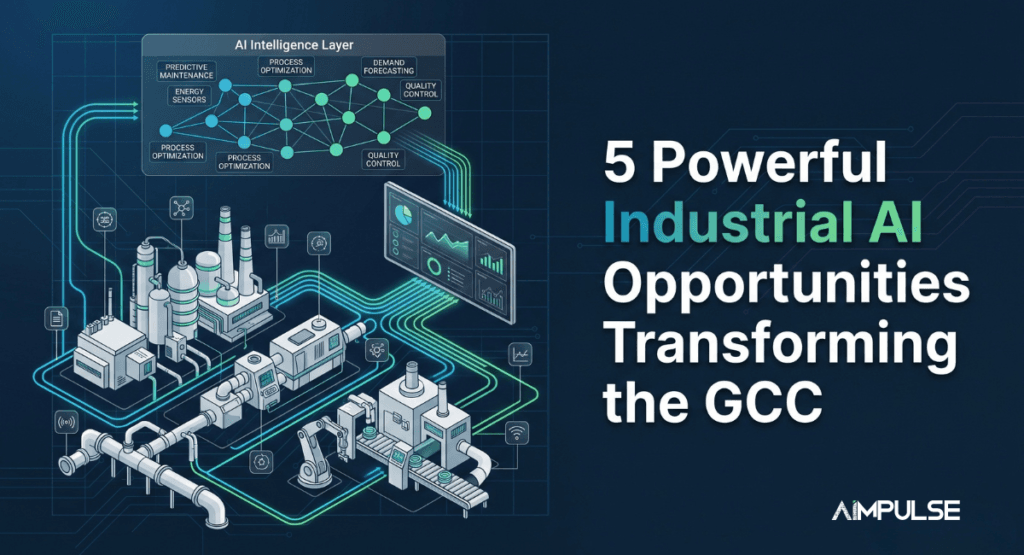
5 Powerful Industrial AI Opportunities Transforming the GCC
Industrial AI GCC is moving from experimentation toward practical industrial value.
Across Saudi Arabia, the UAE, Qatar, Kuwait, Oman and Bahrain, governments and industrial organisations are investing in manufacturing capacity, advanced technology, digital infrastructure and artificial intelligence.
But expanding industrial capacity creates an important question:
Can organisations understand and learn from the assets, systems and operational data they already have?
Saudi Arabia’s National Industrial Strategy illustrates the scale of this transformation. The Kingdom is targeting more than 36,000 factories by 2035, while manufacturing exports are targeted to exceed SAR 557 billion by 2030.
The UAE is pursuing a similar industrial transformation through Operation 300bn, which aims to increase the industrial sector’s contribution to GDP from AED 133 billion to AED 300 billion by 2031.
These ambitions create a major opportunity for industrial AI.
But the next stage of industrial transformation is not simply about adding AI to factories.
It is about understanding existing operational data well enough to identify where AI can create measurable business value.
What Is Industrial AI?
Industrial AI combines artificial intelligence, machine learning, data analytics and automation with real industrial operations.
It can be applied across sectors such as:
- Manufacturing
- Energy
- Petrochemicals
- Mining
- Utilities
- Metals and aluminium
- Logistics
- Desalination
- Industrial infrastructure
Potential applications include:
- Predictive maintenance
- Anomaly detection
- Process optimisation
- Quality control
- Energy optimisation
- Demand forecasting
- Operational intelligence
But industrial AI should not begin with the technology.
It should begin with the operational problem.
A technically impressive AI model creates little value if the underlying data is incomplete, misunderstood or disconnected from the business problem the organisation is trying to solve.
Why Industrial AI Matters Across the GCC
AI adoption across the GCC is advancing rapidly.
BCG research published in 2026 found that 39% of organisations surveyed across Saudi Arabia, Qatar and the UAE qualified as AI Leaders, while 61% remained AI Laggards.
The same research found something even more important:
Around 70% of AI adoption barriers were associated with people, organisation and process issues.
That matters because the limiting factor is not always the AI model.
It may be:
- Poor data quality
- Legacy industrial systems
- Weak data ownership
- Fragmented operational records
- Unclear business objectives
- Limited cross-functional collaboration
- Difficulty measuring AI value
- Insufficient historical data
Where older industrial platforms limit data access, integration or scalability, legacy system modernization can help create a stronger technical foundation for AI adoption.
For organisations evaluating industrial AI GCC opportunities, this changes the starting point.
The first question should not be:
“Which AI platform should we buy?”
It should be:
“What operational problem are we solving, and what evidence do we already have?”
5 Industrial AI Opportunities in the GCC
1. Unlock Existing Machine Data
A modern industrial facility can contain thousands of sensors and still lack usable operational intelligence.
Machines may generate:
- Measurements
- Alarm histories
- Equipment status records
- Process values
- Energy consumption data
- Production information
- Maintenance signals
- Quality measurements
The problem is that machine data is rarely designed for business analysis.
Industrial systems may contain technical identifiers that make complete sense to the original control system but very little sense to a modern analyst or data scientist.
That creates the first industrial AI opportunity:
Data discovery and data resolution.
Instead of immediately replacing existing infrastructure, organisations can begin by investigating what their current systems already record.
This can reveal information about:
- Equipment behaviour
- Alarm patterns
- Production changes
- Process instability
- Energy consumption
- Maintenance conditions
In many cases, organisations already own valuable industrial data.
The challenge is learning how to interpret it.
2. Build Reliable Operational Baselines
AI needs context.
A sensor reading alone does not necessarily tell you whether something is wrong.
Consider a machine reporting a temperature of 80°C.
For one production stage, that may be completely normal.
For another, it could indicate a serious problem.
The difference is context.
A reliable operational baseline helps organisations understand what normal behaviour looks like before they attempt to identify abnormal behaviour.
Historical data can be used to establish:
- Normal operating ranges
- Typical production patterns
- Expected equipment behaviour
- Normal alarm frequency
- Standard process relationships
Once that baseline exists, anomaly detection becomes much more useful.
Where sufficient failure history exists, the same foundation may eventually support predictive maintenance models.
But there is an important rule:
A baseline must represent normal operating conditions.
If abnormal periods are included inside the baseline, the analysis can underestimate the difference between normal and abnormal behaviour.
Good AI starts with a trustworthy reference point.
3. Distinguish Real Problems From Noisy Data
Industrial environments generate noise.
A facility might record 1,000 alarms during one operating period.
That number sounds serious.
But what if 900 of those events were generated by one malfunctioning instrument?
The event volume is high.
The operational impact may be concentrated.
Now imagine 1,000 alarms generated by 250 different instruments across several production areas.
That tells a completely different story.
This is why strong industrial data analytics GCC projects should analyse both:
Volume: How many events occurred?
and
Breadth: How many independent assets generated them?
This simple distinction can prevent organisations from treating noisy data as widespread operational failure.
It can also help engineering teams prioritise investigation.
Instead of asking only:
“How many alarms do we have?”
ask:
“Where are those alarms actually coming from?”
That is a more useful analytical question.
4. Improve the Data Foundation Before Scaling AI
Many organisations successfully build an AI proof of concept.
The difficult part comes next.
Scaling the system across multiple plants, business units or countries requires a much stronger data foundation.
Before scaling industrial AI GCC initiatives, organisations need to understand:
- What data exists?
- Where is it stored?
- Who owns it?
- How reliable is it?
- How frequently is it collected?
- How long is it retained?
- Can historical results be reproduced?
- Can engineers verify the analysis?
- Can systems securely exchange information?
This becomes increasingly important when an AI initiative expands from one facility to ten.
A weak data foundation replicated across ten facilities becomes a much larger problem than a weak foundation inside one pilot project.
Scaling industrial AI also requires the discipline of AI product engineering when analytical capabilities become production systems.
For this reason, scaling AI should not simply mean deploying the same model everywhere.
It should mean building a repeatable operating and data framework.
5. Build Local Analytical Capability
Industrial transformation is not only about technology procurement.
It is also about organisational capability.
A dashboard that only an external supplier can understand creates dependency.
A model whose findings cannot be independently verified creates risk.
A method that engineers, operators and internal technology teams can understand and reproduce creates capability.
For GCC organisations investing in localisation, industrial development and digital transformation, that distinction is strategically important.
The goal should not only be:
“Do we have an AI system?”
It should also be:
“Can our organisation understand, verify and improve what the AI system is doing?”
Strong AI adoption therefore combines technology with:
- Internal knowledge
- Data ownership
- Repeatable analytical methods
- Operational expertise
- Cross-functional collaboration
- Clear performance measures
That is what makes AI scalable rather than dependent.
Industrial AI Across Key GCC Sectors
The opportunity is not identical across every industry.
Different sectors generate different types of data and face different operational priorities.
Petrochemicals and Refining
Process industries generate large volumes of continuously changing operational data.
Industrial analytics can help teams identify abnormal process behaviour, compare equipment conditions and improve the integrity of operational measurements.
The strongest opportunities often begin with clearly defined operational questions rather than broad AI transformation programmes.
Metals and Aluminium
Energy-intensive industrial operations generate significant data around equipment performance, production conditions and energy use.
That creates opportunities for:
- Equipment comparison
- Anomaly detection
- Process optimisation
- Energy analysis
- Quality monitoring
Mining
New industrial and mining assets offer an important advantage:
Data structures can be designed correctly before years of operating history accumulate.
Organisations can define retention policies, equipment identifiers and data standards early rather than trying to reconstruct them later.
Manufacturing
For companies exploring AI in manufacturing GCC, opportunities may include:
- Production analytics
- Quality monitoring
- Equipment anomaly detection
- Maintenance intelligence
- Energy optimisation
- Demand forecasting
However, the correct use case depends on the quality and history of the available data.
Cement and Building Materials
Production facilities often collect more process information than appears in traditional daily or monthly reports.
Industrial data analysis can help expose patterns that are hidden beneath the reporting layer.
Utilities and Desalination
For critical infrastructure, data completeness and verification are particularly important.
Advanced prediction should only be attempted when the underlying historical evidence is reliable enough to support it.
How to Start an Industrial AI Project
The best starting point is rarely:
“Let’s build an AI platform.”
A stronger approach is much more focused.
Step 1: Identify One Operational Problem
Choose a measurable problem.
For example:
- Unplanned equipment behaviour
- Excessive alarms
- Energy inefficiency
- Quality variation
- Production instability
The problem should be specific enough that success can be measured.
Step 2: Read the Existing Data
Determine what information already exists.
Do not assume that the organisation needs a completely new technology stack.
Existing control systems, historians, maintenance systems and reports may already contain valuable information.
Step 3: Establish a Baseline
Understand normal operating behaviour.
Without a reliable baseline, abnormality is difficult to define.
Step 4: Test One Analytical Hypothesis
Do not attempt to solve the entire factory at once.
Test whether the available evidence supports one specific analytical conclusion.
Step 5: Verify the Result
Engineers and stakeholders should be able to reproduce important findings.
AI should not become a black box that nobody inside the organisation can challenge.
Step 6: Scale Only When the Evidence Supports It
A successful pilot should create evidence for the next investment decision.
Scale because the results justify it.
Not because the technology exists.
The AImpulse Industrial AI Method
At AImpulse, we approach industrial AI through five stages:
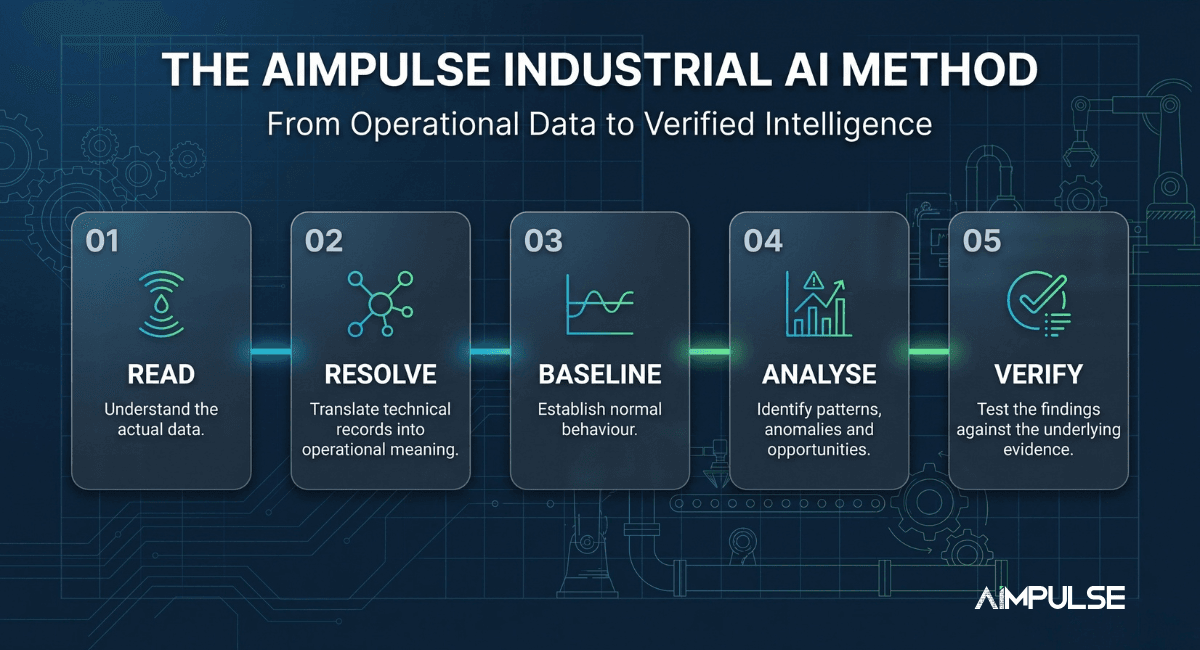
READ → RESOLVE → BASELINE → ANALYSE → VERIFY
READ
Understand the actual data.
Open the existing records, files and systems before defining the final architecture.
RESOLVE
Translate technical records into operational meaning.
Connect identifiers, measurements, alarms and events to the equipment and processes they represent.
BASELINE
Establish normal behaviour.
Use trustworthy historical periods to understand what normal operation actually looks like.
ANALYSE
Identify patterns, anomalies and opportunities.
Test specific operational hypotheses against the evidence.
VERIFY
Test important findings against the underlying data.
Make sure the organisation can reproduce and explain the result.
Only then should the next technology decision be made.
That next step may be:
- Industrial analytics
- Anomaly detection
- Automation
- Predictive modelling
- Operational dashboards
- AI integration
- Additional data collection
The architecture comes after the evidence.
What Industrial AI Cannot Do
Industrial AI cannot create historical evidence that does not exist.
If a facility has never recorded equipment failures in a structured way, it may not have enough information to build a reliable predictive-maintenance model.
No AI platform can manufacture historical failures that were never captured.
In that situation, a more defensible objective may be:
Anomaly detection today + improved data collection + predictive capability tomorrow.
That is not a failure.
It is responsible engineering.
The objective should reflect what the available data can genuinely support.
From Industrial AI Pilot to Scalable Transformation
The commercial challenge begins after the first successful use case.
A pilot can prove that a specific analytical method works.
Scaling requires much more.
Organisations need to consider:
- Data architecture
- Security
- Integration
- Governance
- Monitoring
- Ownership
- Engineering capability
- Operating processes
- Cost
- Reproducibility
This is where many AI programmes struggle.
A strong pilot is not simply a demonstration.
It should answer three questions:
Did the analysis solve a meaningful operational problem?
Can the result be verified?
Can the method be repeated at a larger scale?
If the answer to all three is yes, the organisation has something worth scaling.
Frequently Asked Questions
What is industrial AI?
Industrial AI applies artificial intelligence, machine learning and data analytics to industrial operations such as manufacturing, energy, petrochemicals, mining, utilities and process industries.
How can GCC companies use AI in manufacturing?
Common applications include anomaly detection, predictive maintenance, process optimisation, quality control, energy analysis and operational analytics. The most appropriate use case depends on the organisation’s operational problem and the quality of its available data.
What is the biggest challenge for industrial AI adoption?
Technology is only one part of the challenge. Data quality, legacy systems, unclear ownership, organisational processes, internal capability and measurable business objectives can all affect whether an AI initiative succeeds.
Why is industrial data important for AI?
AI models depend on reliable evidence. Understanding the quality, structure, history and context of industrial data is therefore essential before organisations scale AI.
Should GCC manufacturers replace existing industrial systems before adopting AI?
Not necessarily. Existing systems may already contain useful operational data. Organisations should first understand what their infrastructure records and whether that information can support the intended use case.
Can industrial AI support predictive maintenance?
Yes, but only when sufficient historical failure and maintenance data exists. Where that evidence is limited, anomaly detection and improved data collection may be more realistic first steps.
How should companies scale industrial AI across multiple plants?
Start with a measurable use case, build a reliable data foundation, verify the results, document the analytical method and then expand only when the evidence supports further investment.
How AImpulse Helps
AImpulse helps industrial organisations move from operational data to practical AI opportunities.Our AI-powered business solutions are designed to connect operational data, analytics and practical AI use cases with measurable business outcomes.
We focus on evidence before architecture.
That means understanding what the existing data can support, identifying a high-value operational problem and building the appropriate solution from there.
For organisations exploring industrial AI GCC opportunities, this can include:
- Industrial data analysis
- AI readiness assessments
- Anomaly detection
- Operational intelligence
- AI strategy
- Data-quality improvement
- Integration with existing systems
- Custom industrial AI development
We do not start by assuming that every organisation needs the same platform.
The correct solution may be analytics.
It may be anomaly detection.
It may be system integration.
It may be additional data collection.
Or it may eventually become a custom AI system.
The data should help determine the architecture.
Read first. Understand the evidence. Build what the operation actually needs.
Conclusion
The GCC is expanding industrial capacity at an ambitious pace.
The next challenge is learning from that capacity.
Industrial AI can help organisations turn machine data and operational history into better visibility, stronger decisions and scalable digital capability.
But AI creates sustainable value only when it is grounded in:
- Reliable data
- Clear operational problems
- Verifiable analysis
- Measurable outcomes
- A scalable technical foundation
For organisations investing in industrial AI GCC, the opportunity is not simply to deploy more technology.
It is to build the ability to understand what industrial data already knows.
The organisations that build that capability now will be better positioned to scale industrial AI responsibly across the GCC.
Read first. Resolve the data. Establish the baseline. Analyse the evidence. Verify the result. Then build.
That is the AImpulse approach.