

Industrial AI: 7 Questions to Ask Before You Invest
Industrial AI is often presented as a technology decision.
Which model should we use?
Which platform should we buy?
Should we deploy predictive maintenance?
Do we need a digital twin?
Those are useful questions.
But for many industrial organisations, they come too early.
Before investing in another AI platform, manufacturers should answer a more fundamental question:
What can the data we already have actually support?
Industrial environments can contain years of valuable operational history across control systems, historians, engineering workstations, ERP platforms, maintenance systems, spreadsheets and production reports.
The challenge is not always a lack of data.
Sometimes the real challenge is understanding what the data means, whether it is complete, whether it represents the real operation and what conclusions it can legitimately support.
That is where industrial AI should begin.
Not with the model.
With the evidence.
What Is Industrial AI?
Industrial AI applies artificial intelligence, machine learning and advanced analytics to real industrial operations.
Typical applications include:
Predictive maintenance
Anomaly detection
Production optimisation
Energy optimisation
Quality monitoring
Process analysis
Demand forecasting
Asset performance management
AI-assisted operational decision-making
But industrial AI is only as useful as the operational data behind it.
A sophisticated model trained on incomplete, poorly understood or unrepresentative industrial data can still produce a sophisticated answer to the wrong question.
That is why a strong industrial AI strategy should move from the data outward rather than from the technology inward.
Before deciding what to build, organisations need to understand what they actually have.
7 Questions to Ask Before Investing in Industrial AI
1. What Data Do We Actually Have?
Start with the systems, files and records that already exist.
Do not begin by asking:
“What new data should we collect?”
Begin with:
“What are we already collecting?”
Industrial data may already exist inside:
SCADA systems
Data historians
PLC records
ERP systems
MES platforms
Maintenance systems
CSV exports
Engineering workstations
Operational reports
Energy meters
Sensor databases
Quality systems
In many factories, valuable data already exists but is spread across several systems and understood by different teams.
That fragmentation can make the organisation feel as if it has less usable information than it actually does.
The first stage of industrial AI readiness is therefore discovery.
Open the actual files.
Review the systems.
Understand what exists before purchasing new infrastructure.
This same principle applies to industrial data analytics: the first opportunity is often hidden inside data the organisation already owns.
2. Do We Know What the Data Actually Means?
A column named:
321FN125M01I01
is technically data.
But without context, it may not be useful information.
Industrial systems often contain technical identifiers that made perfect sense to the original commissioning team but become difficult to interpret years later.
The important question is:
Can we connect the raw data to the equipment, measurement, process or event it represents?
Many systems already contain useful configuration information such as:
Point tables
Tag descriptions
Alarm databases
Report definitions
Engineering configuration files
Equipment references
These sources can sometimes act as the dictionary needed to translate technical records into operational meaning.
That step matters because AI cannot compensate for misunderstood variables.
If the system does not know what an input represents, the resulting analysis may be technically correct but operationally meaningless.
Before building a model, resolve the data.
3. What Does Normal Operation Look Like?
Before asking industrial AI to identify anomalies, establish a baseline.
A number by itself rarely tells the full story.
For example:
A temperature of 80°C may be completely normal for one process and a serious warning sign for another.
Five hundred events may be routine during one operating state but highly unusual during another.
Context defines abnormality.
A reliable operational baseline can help answer questions such as:
What is the normal operating range?
How does behaviour change by shift?
What happens during startup and shutdown?
Which measurements normally move together?
What event frequency is typical?
How does behaviour change under different production loads?
There is also an important analytical rule:
Do not allow the incident being investigated to contaminate the baseline.
If abnormal operation is included inside the definition of normal, every conclusion that follows becomes weaker.
Industrial AI needs context before it needs prediction.
4. Are We Measuring Volume or Real Operational Breadth?
Industrial systems can generate enormous numbers of events.
Large numbers often look important.
But event volume alone can be misleading.
Imagine two situations.
Situation A: 59 events generated by two instruments.
Situation B: 1,357 events generated by 179 different instruments.
Both may represent an increase in event volume.
But operationally, they tell very different stories.
The first situation might be caused by one or two noisy or malfunctioning instruments.
The second could indicate a much broader process issue.
A useful industrial data strategy should therefore analyse both:
Volume: How many events occurred?
and:
Breadth: How many independent assets or sources generated them?
This distinction helps separate real operational problems from data noise.
It also prevents teams from turning a large number into a large conclusion without understanding what sits underneath it.
Industrial AI should improve interpretation.
Not simply produce more metrics.
5. Can the Analysis Be Independently Verified?
This is one of the most important industrial AI questions.
If an AI system identifies an operational anomaly, can an engineer trace the result back to the underlying data?
Can the calculation be reproduced?
Can the team understand how the conclusion was reached?
If the answer is no, the organisation may have an impressive dashboard but not necessarily a trustworthy analytical system.
Verification becomes particularly important when analytics supports:
Maintenance decisions
Production changes
Safety-related investigation
Capital investment
Quality decisions
Regulatory environments
Good industrial AI should allow people to understand not only the answer but also the evidence behind the answer.
This requires:
Traceable source data
Reproducible calculations
Clear analytical logic
Versioned data where appropriate
Transparent corrections
Human validation
AI should support engineering judgement.
It should not remove the ability to challenge the result.
6. Do We Have Enough History for the Prediction We Want?
This is where industrial AI projects can become overambitious.
An organisation may ask:
“Can AI predict exactly when this machine will fail?”
But reliable prediction requires something very specific:
Meaningful historical examples of failure.
A plant may have years of sensor readings but limited records showing:
When failures occurred
What component failed
Why it failed
What operating conditions existed beforehand
What maintenance intervention was performed
Without that history, the organisation may not yet have enough evidence for reliable predictive maintenance.
That does not mean the data has no value.
It means the correct starting point may be different.
For example:
Baseline → anomaly detection → better maintenance records → predictive capability
can be a more defensible roadmap than immediately promising failure prediction.
Industrial AI readiness means understanding both what the data can support and what it cannot yet support.
7. What Should We Build After We Understand the Data?
Only now should architecture become the main conversation.
Once the organisation understands:
What data exists
What the data means
What information is missing
What normal operation looks like
Which anomalies are measurable
Whether results can be verified
What business problem matters
the technology decision becomes much clearer.
The appropriate solution might be:
Anomaly detection
Industrial analytics
An operational dashboard
Data integration
Energy analytics
Predictive maintenance
AI-assisted decision support
A machine-learning model
Additional instrumentation
Better data retention
Or no AI implementation yet
That final option is important.
Sometimes the analysis reveals that the real problem is not artificial intelligence.
It may be poor data retention.
It may be an undocumented control system.
It may be fragmented maintenance records.
It may be an integration problem.
It may be instrumentation.
Solving those issues first can create a much stronger foundation for future industrial AI.
The right AI investment is the one justified by the evidence.
The AImpulse Industrial AI Approach
At AImpulse, we use a simple sequence:
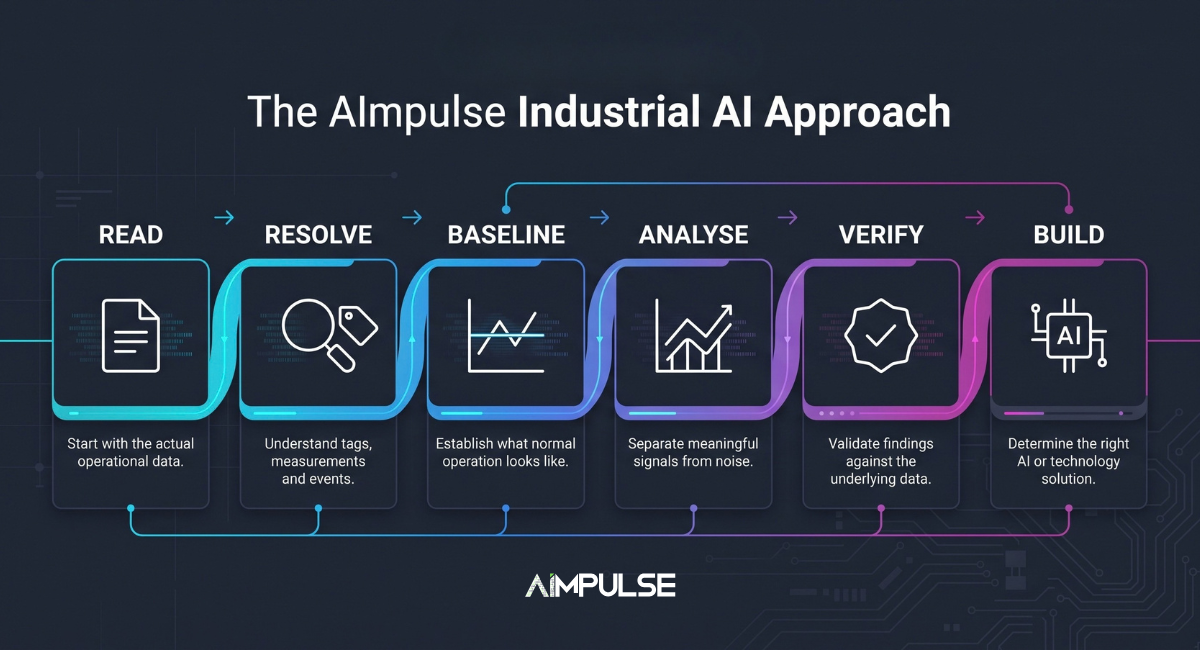
READ → RESOLVE → BASELINE → ANALYSE → VERIFY → BUILD
READ
Start with the actual operational data.
Understand what already exists before defining the final technology architecture.
RESOLVE
Understand what the tags, measurements and events represent.
Translate technical records into operational meaning.
BASELINE
Establish what normal operation looks like.
Create a reliable reference point before searching for anomalies.
ANALYSE
Separate meaningful operational signals from noise.
Look for patterns, relationships, anomalies and measurable opportunities.
VERIFY
Check important findings against the underlying data and operational reality.
The organisation should be able to reproduce and understand the result.
BUILD
Only then determine what technology or industrial AI solution is justified.
This sequence is deliberately different from starting with a technology stack.
Clarity comes before architecture.
Once an analytical opportunity becomes a production system, disciplines such as AI product engineering become increasingly important because the solution must also address architecture, data pipelines, security, monitoring, integrations, reliability and scale.
The objective is not simply to demonstrate that AI can work.
The objective is to build something that continues working in the real operation.
What Industrial AI Can — and Cannot — Tell You
AI can identify patterns, relationships and unusual behaviour that may be difficult to detect manually.
It can support engineers with faster analysis and better visibility.
But industrial AI has limits.
It cannot create historical information that was never recorded.
It cannot automatically determine the meaning of an undocumented sensor.
It cannot reliably predict failures if the organisation has no meaningful history of failures.
And it cannot turn poor-quality data into reliable operational evidence simply because the model is sophisticated.
The more useful question is therefore not:
“Can AI solve this?”
It is:
“What does our data allow us to solve today?”
That question usually leads to better technology decisions and more practical first projects.
When Should You Start an Industrial AI Project?
A good starting point is usually a clearly defined operational problem with accessible data.
For example:
A recurring production anomaly
Unexplained equipment events
High energy consumption
Excessive alarms
Data that exists but is not being used
A maintenance issue with sufficient historical records
A process whose normal operating range can be established
Start with one problem.
Read the data.
Establish the baseline.
Test the hypothesis.
Verify the signal.
Then determine whether industrial AI is actually the right next step.
This approach can reduce unnecessary technology investment while creating a clearer path toward more advanced industrial analytics.
Industrial AI Readiness Across Different Markets
The underlying methodology is global, but industrial priorities differ between markets.
In Finland, the opportunity often involves extracting greater value from mature industrial systems and existing machine data.
Across GCC markets, rapid industrial expansion creates opportunities to build scalable data and AI foundations as new manufacturing capacity grows.
In Egypt, industrial data analytics can support competitiveness, energy visibility and stronger use of existing manufacturing infrastructure.
The technology environment changes.
The fundamental questions do not.
What data exists?
What does it mean?
What can it reliably support?
Those questions should come before architecture in every industrial AI project.
Frequently Asked Questions
What is industrial AI?
Industrial AI uses artificial intelligence, machine learning and advanced analytics to analyse operational data and improve industrial processes, equipment, maintenance and decision-making.
What data is needed for industrial AI?
The required data depends on the use case. It may include machine measurements, equipment events, production records, maintenance history, energy data, quality information and other operational records.
The most important requirement is not simply data volume.
The data must be relevant, understandable and representative of the operational problem.
Can old industrial data be used for AI?
Yes.
Older systems can contain valuable operational history even when their records are poorly documented.
The first step is determining whether the data can be accessed, interpreted and validated.
Does every industrial company need predictive maintenance?
No.
Predictive maintenance requires sufficient historical information about equipment behaviour and failures.
Where that history does not exist, baseline analysis or anomaly detection may be a better starting point.
How should a company start an industrial AI project?
Start with one operational problem and the data that already exists.
Understand the data, establish normal behaviour, validate the findings and then determine which analytical or AI solution is justified.
How do we know if our organisation is ready for industrial AI?
Industrial AI readiness depends on factors such as data accessibility, data quality, technical meaning, historical depth, operational context, verification capability and a clearly defined business problem.
An AI readiness assessment can identify which use cases are realistic now and which require stronger data foundations first.
How AImpulse Helps
Industrial AI does not begin with a model.
It begins with understanding.
AImpulse helps industrial organisations move from raw operational data to evidence-based AI opportunities without forcing a technology solution before the problem is understood.
Our approach can help organisations:
Assess existing industrial data
Resolve undocumented data structures
Establish operational baselines
Identify meaningful anomalies
Evaluate AI readiness
Determine whether prediction is feasible
Design the appropriate data and AI architecture
Build and deploy the resulting solution
The objective is not to add AI simply because AI technology is available.
The objective is to build the right capability because the operational problem and the evidence justify the investment.
If your organisation already has industrial data sitting inside systems that are rarely analysed, the first step may be much simpler than another technology purchase.
Start by understanding what you already have.
Conclusion
The biggest barrier to industrial AI is not always technology.
Often, it is understanding.
Understanding what data exists.
Understanding what the data means.
Understanding what normal looks like.
Understanding what the evidence can actually support.
Once those questions are answered, the technology becomes easier to choose.
That is the principle behind the AImpulse Industrial AI approach:
Read. Resolve. Baseline. Analyse. Verify. Then build.
Because the most valuable industrial AI project may not be the one with the most sophisticated model.
It may be the one that finally turns existing industrial data into measurable operational value.