
Introduction
AI adoption in MENA is no longer limited to technology companies and innovation labs. Across the Gulf and Middle East, organizations are integrating artificial intelligence into operations, customer experiences, and strategic decision-making.
Governments throughout the region are investing heavily in digital transformation, while businesses seek new ways to improve efficiency, reduce costs, and gain a competitive advantage.
From the United Arab Emirates to Saudi Arabia and Qatar, AI is becoming a critical component of economic growth strategies.
This guide explores the biggest trends shaping AI adoption in MENA and how businesses can prepare for the opportunities ahead.
What are the biggest AI trends driving adoption in MENA?
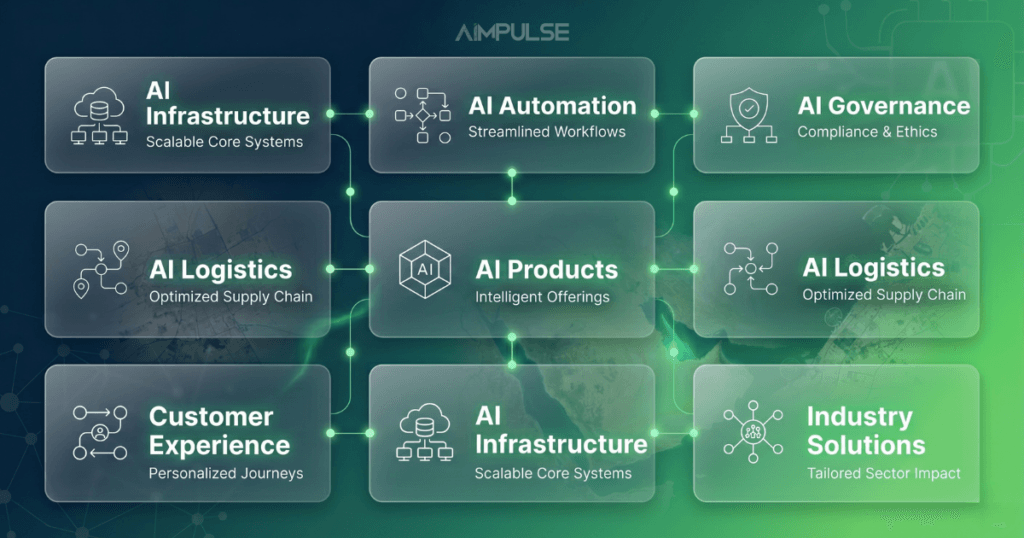
The most significant trends behind AI adoption in MENA include government-led innovation initiatives, AI-powered automation, responsible AI governance, industry-specific AI applications, and growing investment in AI infrastructure.
Organizations that embrace these developments early will be better positioned to compete in the region’s rapidly evolving digital economy.
What is driving AI adoption in MENA?
Several factors are accelerating AI adoption throughout the region.
Government Vision Programs
National initiatives such as Vision 2030 and digital transformation strategies are encouraging organizations to invest in artificial intelligence and emerging technologies.
Governments are actively promoting innovation ecosystems, startup growth, and AI education.
Increased Investment
Private and public sector investments in AI startups, research centers, and enterprise transformation projects continue to grow.
This investment is creating new opportunities for businesses of all sizes.
Digital Transformation Demand
Organizations are under pressure to improve customer experiences, automate processes, and deliver services faster.
AI has become one of the most effective tools for achieving these goals.
Top AI Trends in MENA for 2026
🟦 Trend 1: AI-Powered Business Automation
Businesses are increasingly using AI to automate repetitive processes.
Examples include:
- Customer support automation
- Document processing
- Workflow optimization
- Intelligent reporting
Automation remains one of the fastest ways to generate measurable ROI from AI investments.
🟩 Trend 2: Industry-Specific AI Solutions
Generic AI solutions are giving way to industry-focused applications.
Examples include:
- AI in logistics and supply chain management
- AI for government services
- AI-powered financial operations
- AI-assisted healthcare workflows
Organizations want solutions designed around specific business challenges.
🟧 Trend 3: Responsible AI and Governance
As AI adoption grows, governance becomes increasingly important.
Businesses are focusing on:
- Transparency
- Data governance
- Security
- Ethical AI practices
Responsible AI is becoming a competitive advantage rather than a compliance requirement.
🟨 Trend 4: AI-Enhanced Customer Experience
AI-powered personalization is transforming customer engagement.
Organizations are implementing:
- Intelligent chatbots
- Personalized recommendations
- Customer sentiment analysis
- Automated support systems
These capabilities improve satisfaction while reducing operational costs.
🟪 Trend 5: AI Infrastructure Expansion
Many organizations are investing in AI-ready infrastructure.
This includes:
- Cloud platforms
- Data management systems
- MLOps environments
- AI integration frameworks
Without a strong foundation, AI initiatives struggle to scale effectively.
🟥 Trend 6: AI for Logistics and Supply Chains
The logistics sector is experiencing significant AI transformation.
Use cases include:
- Route optimization
- Predictive maintenance
- Demand forecasting
- Inventory management
This trend is particularly important for regional trade and distribution hubs.
🟫 Trend 7: AI Product Development
Companies are increasingly exploring how to build AI-powered products rather than simply using AI tools.
Examples include:
- AI SaaS platforms
- Intelligent enterprise applications
- Industry-specific AI products
- Custom machine learning solutions
This shift is creating new revenue opportunities across MENA.
Why AI Adoption Matters for Businesses in MENA
Organizations that successfully implement AI can achieve:
- Faster decision-making
- Improved operational efficiency
- Better customer experiences
- Lower operational costs
- New revenue streams
More importantly, AI helps businesses remain competitive in a rapidly changing market.
Companies that delay adoption risk falling behind competitors who are already leveraging AI to improve performance.
Use Cases Across Industries
Logistics & Supply Chain
AI helps optimize routes, predict demand, and improve inventory planning.
Government & Public Sector
AI supports smart city initiatives, citizen services, and administrative automation.
Financial Services
Applications include fraud detection, risk assessment, and customer service automation.
ICT & Technology
AI improves software development, cybersecurity monitoring, and infrastructure management.
How Can Businesses Start Their AI Journey?
Successful AI adoption begins with a structured approach.
1. Identify Business Opportunities
Focus on solving a specific business challenge rather than adopting AI for its own sake.
2. Assess Data Readiness
Review existing data quality, availability, and governance practices.
3. Launch a Pilot Project
Start small and measure outcomes before scaling.
4. Establish Governance
Define clear policies around security, privacy, and AI usage.
5. Scale Gradually
Expand successful initiatives into broader business functions.
AImpulse Insight
Many organizations assume they need a large AI transformation project to get started.
In reality, the most successful initiatives often begin with a focused pilot that delivers measurable value quickly.
This approach reduces risk while building internal confidence and momentum.
Common Mistakes to Avoid
Treating AI as a Technology Project
AI initiatives should be tied directly to business objectives.
Ignoring Data Quality
Poor data leads to poor outcomes.
Lack of Executive Alignment
Successful AI programs require support from leadership.
Scaling Too Quickly
Organizations should validate results before expanding deployments.
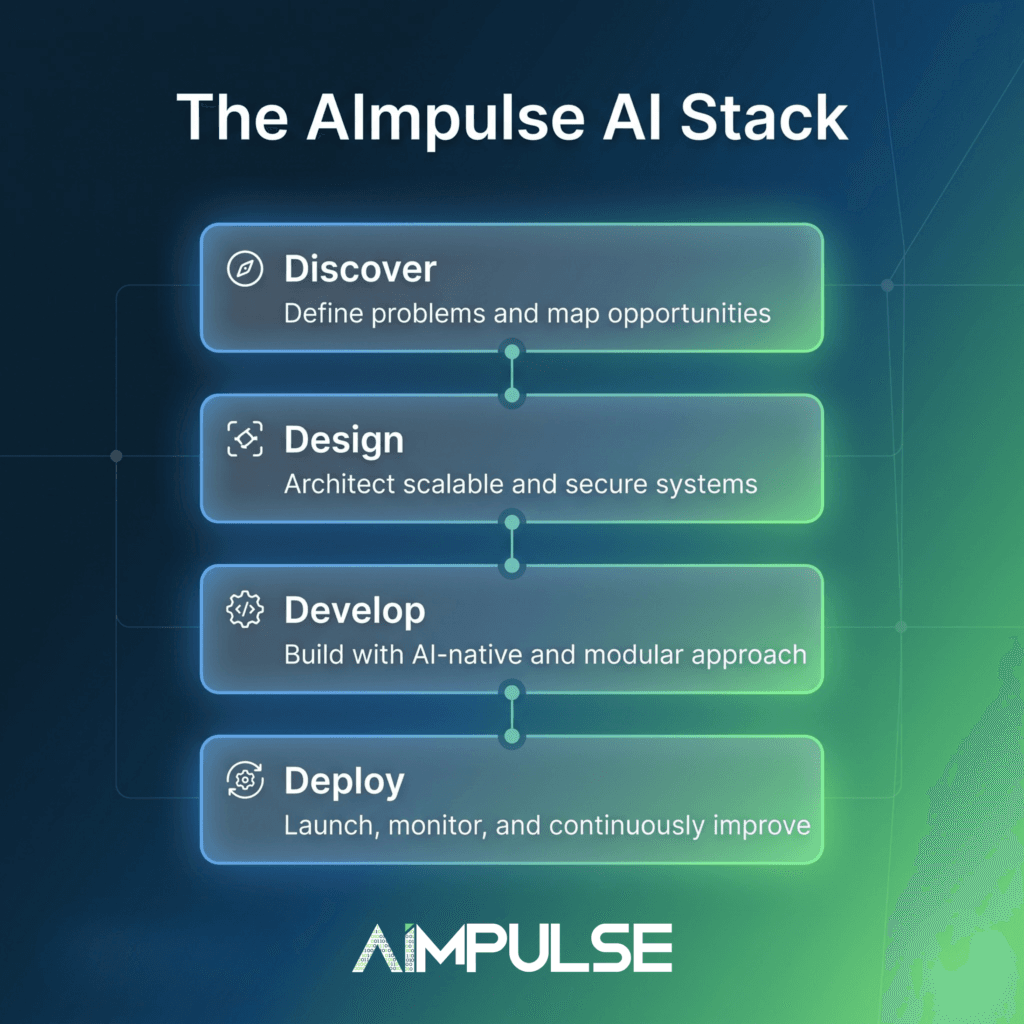
The AImpulse AI Framework
AImpulse AI Stack
Discover
Identify high-impact opportunities and business goals.
Design
Develop scalable and secure AI architectures.
Develop
Build practical AI solutions aligned with operational needs.
Deploy & Scale
Monitor, optimize, and expand successful implementations.
This framework helps organizations move from experimentation to measurable business value.
How AImpulse Helps
AImpulse supports organizations throughout their AI transformation journey.
We help businesses:
- Build AI strategies
- Develop custom AI solutions
- Create AI-powered products
- Implement secure and scalable systems
- Establish AI governance frameworks
Our focus is simple:
Build AI solutions that deliver real business outcomes.
If you’re exploring AI adoption across industries, you may also find our guide on AI trends in Europe useful for understanding the broader landscape.
Frequently Asked Questions
What is AI adoption in MENA?
AI adoption in MENA refers to the growing use of artificial intelligence technologies by businesses, governments, and organizations across the Middle East and North Africa.
Which industries are adopting AI fastest in MENA?
Logistics, financial services, government, healthcare, and technology sectors are among the fastest adopters.
Why is AI important for businesses in MENA?
AI improves efficiency, enhances customer experiences, reduces costs, and creates new growth opportunities.
How can companies start using AI?
Most organizations begin with a focused pilot project that addresses a specific business challenge before expanding AI initiatives.
Conclusion
The future of AI adoption in MENA is being shaped by innovation, investment, and digital transformation.
Organizations that act today will be better positioned to compete tomorrow.
As AI becomes more accessible and practical, the opportunity is no longer about whether businesses should adopt AI—it is about how quickly they can implement it successfully.
Ready to explore how AI can create value for your organization?
Let’s start the conversation.
👉 This is typically how we help teams validate AI opportunities before scaling. You can also explore how we build scalable solutions on our AI development services page.
Curious how these trends apply to your business?
👉 Let’s explore your use case together — no pressure, just clarity.