
Introduction:
Artificial intelligence is no longer a future advantage—it’s a present-day requirement. Businesses that understand the AI trends Europe 2026 will shape markets, while others struggle to keep up. Across Germany, the Netherlands, and Finland, we’re already seeing companies move from experimentation to real deployment. This shift is redefining how innovation happens in Europe. AI Trends Europe 2026 will continue to evolve as new technologies emerge.
What are the top AI trends in Europe in 2026?
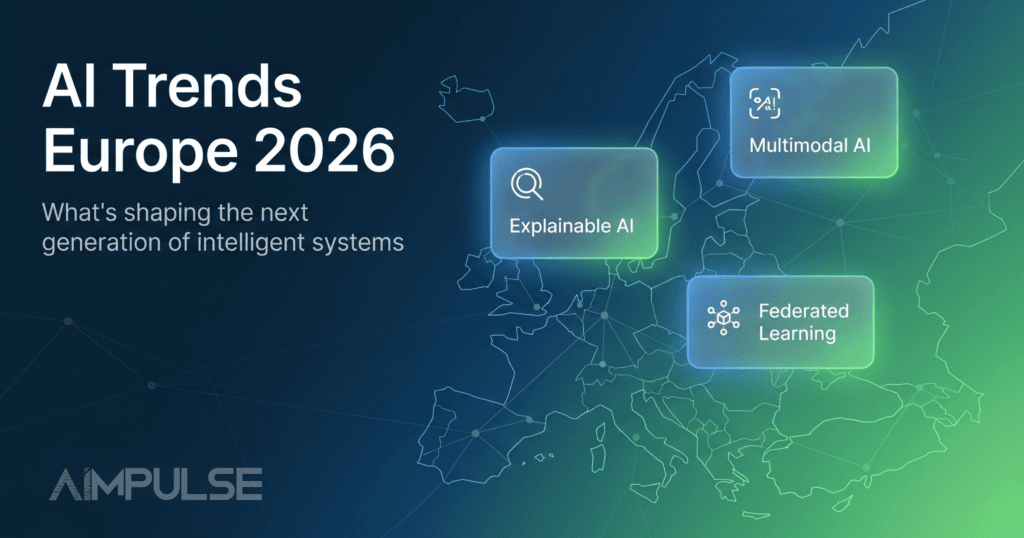
The top AI trends in Europe in 2026 include explainable AI, multimodal AI systems, and federated learning, driven by strict regulations like the EU AI Act and increasing enterprise adoption across industries.
These AI trends in Europe 2026 are crucial for businesses aiming for a competitive edge.
The importance of understanding AI trends in Europe 2026 cannot be understated, as it directly influences strategic planning.
What is driving AI growth in Europe?
These factors are critical in shaping AI trends Europe 2026 and ensuring businesses stay ahead.
AI adoption in Europe is accelerating due to three major forces:
The shift towards AI trends Europe 2026 is compelling businesses to innovate.
Regulatory clarity: The EU AI Act is pushing companies toward responsible AI
Investment growth: Funding in deep tech and AI startups is rising
Talent expansion: Cities like Berlin, Helsinki, and Amsterdam are becoming AI hubs
Understanding the AI trends Europe 2026 will help identify emerging opportunities.
From our work with clients across Europe, one clear shift stands out:
Companies must stay informed about AI trends in Europe 2026 to maintain their market position.
We need to continually assess how AI trends in Europe 2026 impact our industry.
👉 Companies are no longer asking “Should we use AI?”
They are asking, “How fast can we deploy it safely?”
This shift is what’s driving real AI innovation in Europe today.
Top AI trends Europe 2026
Instead of generic trends, here’s what’s actually shaping real-world implementation:
🟦 Trend 1: Explainable AI (XAI)
Explainable AI is becoming essential due to regulatory pressure.
In industries like fintech and healthcare, companies must justify every AI decision.
Improves trust and transparency
Supports GDPR and EU AI Act compliance
Reduces legal and operational risk
👉 In practice, we’ve seen companies reject “black-box models” entirely in regulated environments.
🟩 Trend 2: Multimodal AI systems
Multimodal AI combines text, images, audio, and structured data.
In Europe, this is already being used for:
Customer support automation
Medical diagnostics (image + patient data)
Fraud detection systems
This is one of the fastest-growing AI technologies in 2026.
🟧 Trend 3: Federated Learning
Federated learning allows AI models to train without moving sensitive data.
Those who adapt to AI trends Europe 2026 will likely achieve greater success.
This is critical for:
Aligning with the AI trends Europe 2026 is essential for sustainable growth.
GDPR compliance
Cross-border data usage
Privacy-first AI systems
👉 Especially relevant in Germany and the Netherlands, where data privacy standards are strict.
Why it matters for businesses in Europe
AI is no longer a “nice to have.”
Companies that adopt AI early gain:
Faster decision-making
Better customer insights
Lower operational costs
A strong AI strategy in Europe must balance the following:
Innovation
Compliance
Scalability
Ignoring this balance is where most companies fail.
Use cases across industries
💳 AI in fintech Europe
Explainable credit scoring
Fraud detection using federated learning
🏥 AI in healthcare Europe
Multimodal diagnostics
Patient risk prediction
💻 AI in ICT sector
Network optimization
AI-driven cybersecurity
How can companies adopt AI Europe?
Adopting AI doesn’t require a massive transformation from day one.
Start with this practical approach:
- Audit your data
Understand what data you have and its quality
- Define a clear use case
Focus on a specific business problem
- Start with a pilot
Test a small AI solution before scaling
- Ensure compliance early
Align with GDPR and AI Act requirements from day one
If you’re unsure where to start, most companies begin with a small AI pilot focused on a single use case.
👉 This is typically how we help teams validate AI opportunities before scaling.
Common mistakes to avoid
Ignoring explainability → leads to compliance risks
Treating AI as a one-time project → AI needs continuous optimization
Skipping human oversight → critical in high-risk decisions
The AImpulse AI Approach
Exploring AI trends in Europe 2026 will inform our strategy moving forward.
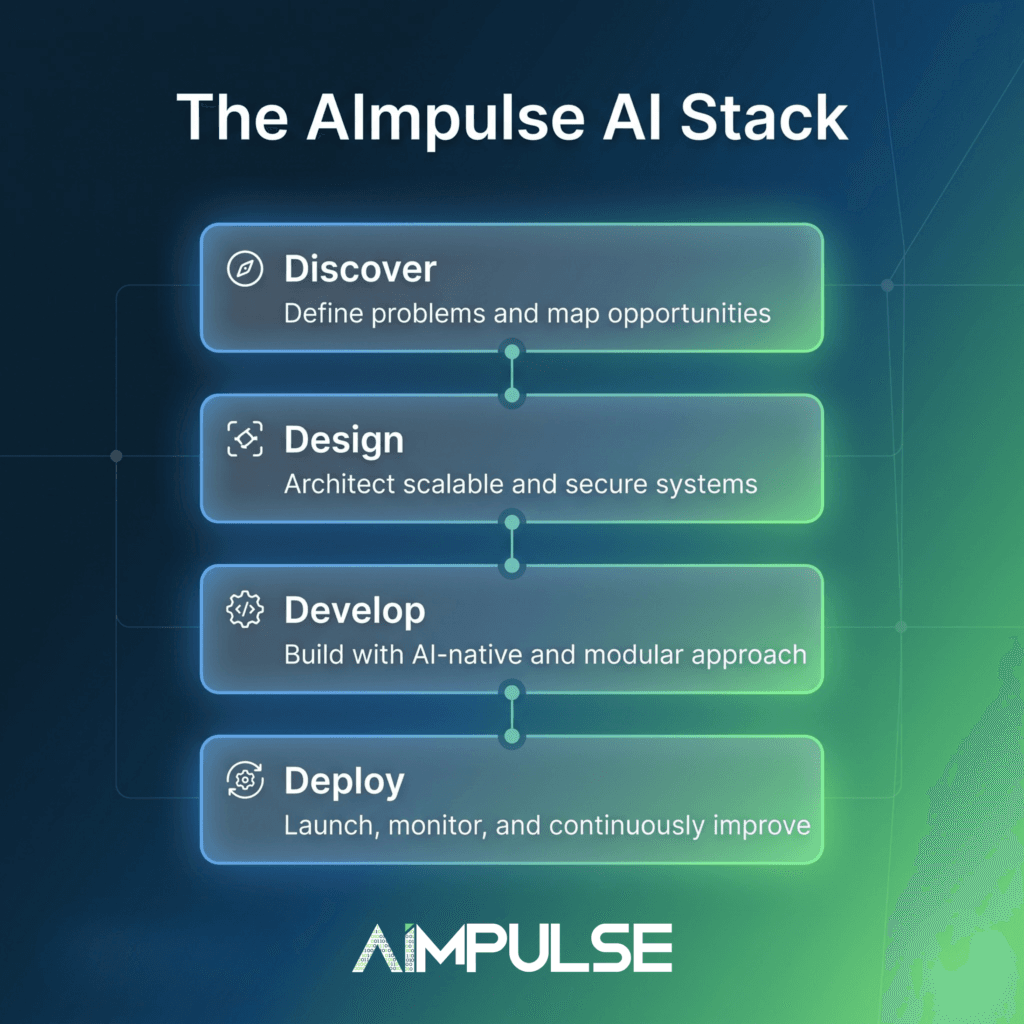
At AImpulse, we follow a simple but powerful model:
🧠 AImpulse AI Stack
Discover → Identify high-impact AI opportunities
Design → Build compliant, explainable architecture
Develop → Rapid AI implementation using modern tools
Deploy & Scale → Monitor, improve, and expand
👉 This ensures every AI solution is:
Scalable
Secure
Regulation-ready
How AImpulse helps
We help companies across Europe:
Design AI strategies aligned with regulations
Build explainable and secure AI systems
Launch scalable AI products
Engaging with AI trends Europe 2026 is becoming a vital part of our operational strategy.
We don’t just build AI.
👉 We build AI that works in the real world.
Frequently Asked Questions
What are the top AI trends in Europe?
- The top AI trends in Europe include explainable AI, multimodal systems, and federated learning, driven by regulatory requirements and enterprise adoption.
Why is explainable AI important in Europe?
- Explainable AI is important because European regulations require transparency in automated decision-making, especially in finance and healthcare.
How can companies adopt AI in Europe?
- Companies can adopt AI by starting with a pilot project, ensuring data readiness, and aligning with GDPR and EU AI Act requirements from the beginning.
Conclusion
By staying ahead of AI trends Europe 2026, companies can optimize their offerings.
The engagement with AI Trends Europe 2026 is crucial for future-proofing businesses.
The AI trends in Europe 2026 are clear:
👉 AI is becoming more transparent, regulated, and practical
Companies that move early—and move correctly—will lead.
Curious how these trends apply to your business?
👉 Let’s explore your use case together — no pressure, just clarity.