

AI MVP Development: 7 Powerful Steps to Launch in 2026
Introduction
You have the idea. You may even have the business model, early customer conversations, or a prototype.
But there is a critical question every founder eventually faces: How do you turn an AI idea into a real product without spending months and a large budget building something nobody needs?
That is where AI MVP development becomes valuable.
An AI MVP gives founders a focused way to test a product idea, validate the core user experience, and learn from real users before investing in a larger platform. The goal is not to build the biggest AI product. It is to build enough of the right product to learn what should come next.
In this guide, you will learn what an AI MVP is, how to build one in seven practical steps, what affects development costs, and when to integrate existing AI instead of building a custom model.
What Is an AI MVP?
An AI MVP (artificial intelligence minimum viable product) is a minimum viable product that uses AI as a meaningful part of its core functionality. The product is deliberately limited in scope so a team can test whether a specific AI-powered workflow solves a real problem.
An AI MVP could be:
An AI-powered SaaS platform
An intelligent document-processing system
A customer-support assistant
A predictive analytics product
An AI recommendation engine
An AI-powered internal business tool
An intelligent workflow or automation platform
The important distinction is between an AI demo and an AI product. A demo proves that something can work. An MVP helps determine whether people need it, use it, and receive enough value from it to justify further investment.
That is why a strong AI MVP focuses on the user outcome and the AI-assisted workflow, not simply an impressive technical demonstration. As the product matures, broader AI product engineering practices help move it from a working prototype to reliable software.
Why Startups Need an AI MVP
AI has lowered the barrier to experimenting with new products, but that does not mean every AI idea deserves a full product build.
A focused MVP can help founders answer essential questions:
Do customers actually have this problem?
Will they use an AI-powered solution?
Is the AI accurate enough for the intended workflow?
Which features are genuinely necessary?
How much value will users pay for?
What technical limitations emerge during real-world use?
This makes AI MVP development for startups a validation exercise as much as an engineering exercise.
Instead of spending months building ten features, you can concentrate on one valuable workflow. Use real feedback to decide what deserves further investment. If you are still validating demand, start with AImpulse’s guide to validating a startup idea before building an MVP.
7 Steps to Build an AI MVP
The following AI MVP development process moves from problem discovery to a controlled launch and evidence-based scaling.
1. Define the Problem Before the Technology
Do not begin with: “We want to build an AI platform.”
Begin with: “We want to help this specific user solve this specific problem.”
For example:
Weak problem statement: “AI for logistics.”
Stronger problem statement: “Help logistics managers predict delayed shipments before they impact customers.”
The second statement gives your team an identifiable user, a defined workflow, and an outcome you can measure.
Before development begins, define the target user, core problem, current alternative, desired outcome, business value, and success metric. This prevents technology from becoming the strategy.
2. Validate the AI Use Case
Not every business problem needs AI. Sometimes a traditional software workflow, automation rule, or API integration is the better solution.
Your AI use case should answer three questions:
Can AI improve the existing process?
Can the improvement be measured?
Is the improvement valuable enough to justify the added complexity?
AI may be appropriate for classification, prediction, recommendation, natural-language interaction, document processing, pattern detection, personalization, and intelligent automation.
For example, a document-processing MVP might aim to reduce manual review time while keeping a human responsible for approving uncertain results. Success should be assessed against a defined baseline, not a demonstration that looks impressive.
Good AI product development starts with the business outcome rather than the model.
3. Define the Smallest Useful MVP
One of the biggest mistakes founders make is trying to build the complete vision immediately. Your first version should usually focus on one core workflow:
Input → AI processing → User action → Measurable outcome
Imagine an AI recruitment product. Instead of launching AI interviews, candidate scoring, job matching, payroll, employee management, analytics, and a CRM at the same time, start with a focused flow:
Analyze CV → Match candidate to job → Explain match → Allow recruiter approval
That can be enough to test whether the core workflow creates real value.
Write down what is included in the first release and, just as importantly, what is excluded. A smaller, testable scope makes it easier to estimate effort, identify failure cases, and learn from users.
4. Design the AI and Product Architecture
Once the use case is validated, determine how the product should work end to end.
Depending on the requirements, your architecture may include:
Frontend application and backend services
Database and data pipelines
AI model or model API
Retrieval system, when needed
Authentication and authorization
APIs and third-party integrations
Cloud infrastructure and monitoring
Security and operational controls
Do not automatically assume that you need to train your own AI model. For many early products, existing models and APIs provide a faster route to validation. A custom model may become appropriate later when proprietary data, performance, economics, or domain-specific requirements justify the investment.
For products that will evolve into subscription platforms, it is also worth understanding the principles of cloud-native SaaS architecture. The architecture should serve the product requirements, not whichever AI technology is trending.
5. Build Evaluation and Security Into the MVP
Traditional software often produces predictable outputs for a given input. AI systems introduce uncertainty: how do you know the AI is performing well enough for the intended use?
Define the following before launch:
Accuracy or quality benchmarks
Expected outputs and known failure cases
Human review and escalation requirements
Data protection and access requirements
Monitoring and incident response
Cost per interaction or completed task
Security needs attention from the beginning. Depending on your product, that may include authentication, authorization, encryption, API security, access controls, logging, data retention policies, and protection against prompt injection.
The NIST AI Risk Management Framework provides guidance for identifying and managing AI risks. For software delivery, NIST’s Secure Software Development Framework offers foundational secure-development practices. Teams building with language models should also review the OWASP Top 10 for LLM Applications for common AI application security risks.
AI product development involves more than model implementation. Product strategy, architecture, data, security, cloud, integration, and evaluation must work together.
6. Launch With Real Users
An MVP is not finished simply because the development team has completed its feature list. Its purpose is to generate meaningful evidence from real users.
Start with a controlled group that represents your intended audience. Measure:
Activation and first-value experience
Usage and workflow completion rate
AI output quality and user corrections
Retention and repeat usage
Conversion or willingness to pay
Cost per user or successful workflow
For example, if an AI assistant helps staff process documents, measure whether users complete the process accurately, how often they need to correct results, and whether the workflow saves useful time.
The goal is not simply to collect opinions. You want behavioral evidence. Repeat usage, completed workflows, and measurable user value give you stronger reasons to invest in the next release.
7. Iterate Before You Scale
This is where the MVP begins to become a product. Use what you learn to decide:
Keep → Improve → Remove → Build next
Your first release might show that customers do not care about three planned features but urgently need an integration that was not on your original roadmap. That is useful information.
The purpose of AI MVP development is not to prove that the original idea was perfect. It is to discover what the product needs to become. Improve reliability, usability, cost efficiency, and architecture based on evidence before increasing infrastructure or adding complexity.
Common AI MVP Mistakes
Building Too Many Features
More features do not automatically create more value. Start with the core workflow and expand when user behavior supports it.
Choosing AI Before Defining the Problem
AI should solve a business problem, not become the business problem. Confirm that intelligent processing adds value beyond simpler alternatives.
Ignoring Data Requirements
An AI product may depend on data that is incomplete, inconsistent, inaccessible, or difficult to structure. Review data availability and quality before committing to a model or timeline.
Treating the AI Model as the Product
A model is only one component. The full product also requires user experience, workflows, integrations, security, infrastructure, evaluation, and a sustainable business model.
Waiting Too Long to Talk to Users
The earlier real users interact with the product, the faster your team can learn which assumptions are correct and which need to change.
How Much Does AI MVP Development Cost?
There is no single price for an AI MVP. AI MVP development cost varies significantly depending on the scope and complexity of the product.
Important cost drivers include:
Number and complexity of workflows
Data preparation and quality requirements
AI model selection and customization
Third-party integrations
Security and compliance needs
Cloud infrastructure and API usage
UI/UX requirements
Testing, evaluation, and ongoing monitoring
A narrowly scoped application built around an existing AI API may have a different budget from a platform requiring custom models, regulated data, or complex enterprise integrations. Initial development cost is also different from ongoing operating cost, which may include model usage, hosting, monitoring, support, and iteration.
That is why a meaningful discovery and scoping phase should happen before committing to a fixed development budget. Define the workflow, technical dependencies, success criteria, and expected usage first; then request an estimate based on those requirements.
When Should You Build vs. Integrate AI?
You do not always need to build an AI system from scratch.
Integrate existing AI when:
You need to validate demand quickly.
A suitable model already exists.
Your differentiation is primarily in the workflow or user experience.
You do not yet have enough proprietary data.
Speed of learning matters more than owning the underlying model.
Consider custom AI development when:
Your data creates a meaningful competitive advantage.
Existing models cannot meet performance requirements.
You need specialized, domain-specific behavior.
Unit economics justify customization.
Your product requires greater control over the AI system.
The right question is not simply, “Should we build our own AI?” It is, “What technology gives our product the best path to measurable value?”
The AImpulse AI Product Framework
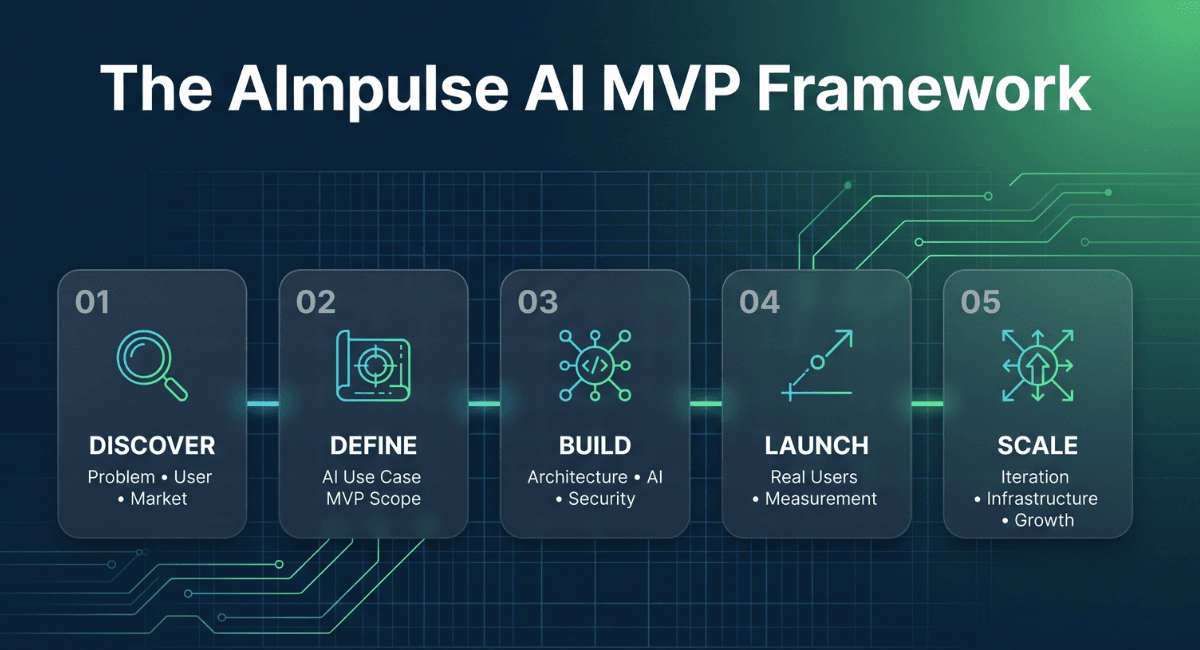
At AImpulse, we approach product development through five connected stages. These five broader phases summarize the seven execution steps above, from initial discovery through scaling.
Discover
Understand the problem, target users, market, and business opportunity.
Define
Identify the core AI use case, define the smallest useful scope, and establish measurable success criteria.
Build
Develop the MVP with appropriate architecture, AI capabilities, evaluation, and security controls.
Launch
Put the product in front of real users and collect evidence about its usefulness and performance.
Scale
Improve the product, architecture, AI performance, and infrastructure based on real-world results.
Idea → Validation → MVP → Launch → Scale
This approach keeps product strategy and engineering connected from the beginning.
How AImpulse Helps
Building an AI MVP requires more than developers. Successful products connect product strategy → UX → AI → engineering → security → cloud → go-to-market → growth.
AImpulse supports founders and businesses with validating AI product opportunities, defining MVP scope, designing product architecture, developing AI-powered applications, integrating AI into existing platforms, building secure infrastructure, launching with real users, and improving products after launch.
For founders who need both technology and market execution, AImpulse Studio combines AI product development with branding, go-to-market strategy, and growth systems through its partnership with Teddy Tech Solutions.
Do not build the entire vision before testing the first assumption. Start with the right problem, build the right MVP, learn from real users, and scale what works.
Frequently Asked Questions
What is AI MVP development?
AI MVP development is the process of building a minimum viable product in which artificial intelligence plays an important role in solving a specific user or business problem. The goal is to validate the product before investing in a larger platform.
How do you build an AI MVP?
The usual process is to define the problem, validate the AI use case, scope the MVP, design the architecture, build and evaluate the AI workflow, launch with real users, and iterate based on measurable results.
How long does AI MVP development take?
The timeline depends on product complexity, integrations, data requirements, and AI functionality. A narrowly scoped MVP can be developed faster than a product involving multiple workflows, complex integrations, or custom models. A realistic timeline requires discovery and scope definition.
How much does an AI MVP cost?
Costs depend on scope, data requirements, integrations, security, AI complexity, infrastructure, and ongoing usage. A discovery phase is generally needed to produce a realistic estimate for a particular product.
Should startups build their own AI model?
Not necessarily. Many startups can validate a product using existing AI models or APIs first. Custom models can be considered later when data, performance, economics, or domain-specific requirements justify them.
What makes an AI MVP successful?
A successful AI MVP solves a specific problem, delivers measurable user value, performs reliably enough for its intended workflow, and generates evidence that helps the team decide what to build next.
Conclusion
The fastest way to build an AI product is not necessarily to build faster. It is to learn faster.
A focused MVP allows founders to test the problem, validate an AI use case, understand users, measure product performance, and make better investment decisions before scaling.
The strongest AI products are not built around AI for its own sake. They are built around real problems, real users, and measurable outcomes. That is the philosophy behind AImpulse.
Have an AI product idea worth testing? Talk to AImpulse about turning your idea into a product you can validate, launch, and scale.