
EU AI Act Explained: What Every Business Must Do Before 2027
The EU AI Act is the first comprehensive AI regulation of its kind, and it is already reshaping how European businesses build, buy, and deploy artificial intelligence. For CTOs, compliance leads, and product teams, the question is no longer whether the regulation applies — it’s whether their AI systems are correctly classified, documented, and ready for the deadlines that arrive between 2026 and 2027.
This article explains what the EU AI Act actually requires, who it affects, how risk categories work, and the practical steps your business needs to take now to stay compliant.
Note: The EU AI Act’s implementation timeline has been subject to proposed adjustments through the European Commission’s “AI Digital Omnibus” process. This article reflects the framework as currently understood; businesses should confirm the latest deadlines through the European Commission’s official AI Act page before finalizing compliance plans.
Table of Contents
- What is the EU AI Act?
- Who does it affect?
- Risk categories under the EU AI Act
- Compliance checklist
- Implementation roadmap
- The AImpulse Compliance Framework
- FAQ
What is the EU AI Act?
The EU AI Act is a binding European Union regulation that establishes rules for developing, deploying, and using artificial intelligence systems across all member states. It takes a risk-based approach to AI governance: the higher the potential harm an AI system could cause to safety, rights, or democratic processes, the stricter the obligations placed on it.
Rather than regulating a single technology, the Act regulates use cases — the same underlying AI model can be lightly regulated in one context and heavily regulated in another, depending on how it is applied.
Who Does It Affect?
The EU AI Act applies broadly across the AI supply chain, not only to companies headquartered in the EU.
- Providers — organizations that develop or place an AI system on the EU market.
- Deployers — organizations that use an AI system in the course of business operations within the EU.
- Importers and distributors — companies that bring AI systems into the EU market from elsewhere.
- Non-EU companies — any business whose AI system output is used within the EU, regardless of where the company is based.
In practice, this means most enterprises building or using AI in Europe — from fintech to healthcare to manufacturing — will fall under some tier of obligation, even if their core product is not “AI” in a marketing sense.
Risk Categories Under the EU AI Act
The EU AI Act’s risk classification model is central to determining what compliance actually requires.
Unacceptable Risk
A small set of AI practices are prohibited outright, including certain forms of social scoring, manipulative AI systems that exploit vulnerabilities, and untargeted biometric scraping. These systems cannot legally be deployed in the EU under any circumstances.
High Risk AI
High-risk AI systems include applications used in employment decisions, credit scoring, critical infrastructure, education access, medical devices, and law enforcement. These systems face the strictest obligations: risk management systems, data governance controls, technical documentation, human oversight, logging, and conformity assessment before market entry.
Limited Risk
Limited-risk systems — such as chatbots and AI systems generating synthetic content — carry transparency obligations. Businesses must ensure users know they are interacting with AI, and that AI-generated content is clearly identifiable.
Minimal Risk
The majority of everyday AI applications, such as spam filters or AI-enabled inventory tools, fall into this category. They carry no mandatory obligations under the Act, though voluntary codes of conduct are encouraged.
Compliance Checklist
Businesses preparing for the EU AI Act should work through the following before relevant deadlines take effect:
- Inventory every AI system in use or development across the organization.
- Classify each system against the Act’s four risk tiers.
- Identify which systems qualify as high-risk under Annex III or Annex I criteria.
- Establish a risk management and data governance process for high-risk systems.
- Prepare technical documentation demonstrating how each system was designed, tested, and monitored.
- Implement human oversight mechanisms for high-risk decisions.
- Ensure transparency disclosures for chatbots and synthetic content tools.
- Assign clear internal ownership for ongoing AI governance and monitoring.
You can read more about SSDLC and real use cases to across industries here.
Implementation Roadmap
A practical rollout typically follows this sequence:
- Weeks 1–4: Full AI system inventory and initial risk classification.
- Weeks 5–8: Gap analysis against required documentation, oversight, and governance controls.
- Weeks 9–16: Remediation — building missing controls, documentation, and monitoring processes.
- Weeks 17–20: Internal audit and readiness review ahead of applicable deadlines.
- Ongoing: Continuous monitoring, retraining oversight, and regulatory tracking, since obligations and timelines continue to evolve.
If you’re unsure whether your AI solution complies with upcoming regulations, AImpulse helps businesses build secure, compliant AI products from day one. Talk to AImpulse about your compliance readiness.
The AImpulse Compliance Framework
MiD ARTICLE – IMAGE
AImpulse supports European businesses through a structured five-stage framework for EU AI Act readiness:
- Assess — Inventory all AI systems and evaluate current governance maturity.
- Classify — Map each system against the Act’s risk tiers to determine applicable obligations.
- Document — Build the technical documentation, data governance records, and risk management files required for high-risk systems.
- Implement — Put oversight mechanisms, logging, and transparency measures into production systems.
- Monitor — Continuously track regulatory updates, system performance, and audit readiness over time.
Frequently Asked Questions
What is the EU AI Act?
The EU AI Act is a binding European regulation that governs how AI systems are developed and used, based on a risk classification model. It sets obligations ranging from outright prohibition for unacceptable-risk systems to transparency requirements for lower-risk applications like chatbots.
Who does the EU AI Act apply to?
It applies to providers, deployers, importers, and distributors of AI systems used within the EU, including non-EU companies whose AI outputs are used by EU-based individuals or organizations. Most enterprises operating in Europe will have some level of obligation.
What are the risk categories under the EU AI Act?
The Act defines four risk tiers: unacceptable risk (prohibited), high risk (strict obligations including documentation and oversight), limited risk (transparency requirements), and minimal risk (largely unregulated). Classification determines exactly what compliance work is required.
What should businesses do to prepare?
Businesses should inventory all AI systems, classify each against the Act’s risk tiers, and build documentation, oversight, and monitoring processes for anything falling into the high-risk category. Starting early avoids costly retrofits once deadlines are enforced.
How can AImpulse help with EU AI Act compliance?
AImpulse helps businesses assess, classify, and implement compliant AI systems using a structured five-stage framework. This includes technical documentation, governance processes, and monitoring designed to keep pace with the Act’s evolving requirements.
Conclusion
The EU AI Act represents a fundamental shift in how AI systems must be designed, documented, and governed across Europe. The businesses that adapt successfully are the ones treating compliance as a design principle from day one, not a retrofit exercise once deadlines are enforced. With obligations phasing in through 2026 and 2027, now is the time to inventory your AI systems, classify them accurately, and close any governance gaps before enforcement intensifies.
If your business needs help assessing AI compliance readiness or building AI products designed for responsible AI from the start, talk to AImpulse or follow AImpulse on LinkedIn for ongoing updates on AI regulation across Europe.
Learn More From These Extra Resources
EU AI Act Explained: What Every Business Must Do Before 2027
The EU AI Act is the first comprehensive AI regulation of its kind, and it is already reshaping how European businesses build, buy, and deploy artificial intelligence. For CTOs, compliance leads, and product teams, the question is no longer whether the regulation applies — it’s whether their AI systems are correctly classified, documented, and ready for the deadlines that arrive between 2026 and 2027.
This article explains what the EU AI Act actually requires, who it affects, how risk categories work, and the practical steps your business needs to take now to stay compliant.
Note: The EU AI Act’s implementation timeline has been subject to proposed adjustments through the European Commission’s “AI Digital Omnibus” process. This article reflects the framework as currently understood; businesses should confirm the latest deadlines through the European Commission’s official AI Act page before finalizing compliance plans.
Table of Contents
- What is the EU AI Act?
- Who does it affect?
- Risk categories under the EU AI Act
- Compliance checklist
- Implementation roadmap
- The AImpulse Compliance Framework
- FAQ
What is the EU AI Act?
The EU AI Act is a binding European Union regulation that establishes rules for developing, deploying, and using artificial intelligence systems across all member states. It takes a risk-based approach to AI governance: the higher the potential harm an AI system could cause to safety, rights, or democratic processes, the stricter the obligations placed on it.
Rather than regulating a single technology, the Act regulates use cases — the same underlying AI model can be lightly regulated in one context and heavily regulated in another, depending on how it is applied.
Who Does It Affect?
The EU AI Act applies broadly across the AI supply chain, not only to companies headquartered in the EU.
- Providers — organizations that develop or place an AI system on the EU market.
- Deployers — organizations that use an AI system in the course of business operations within the EU.
- Importers and distributors — companies that bring AI systems into the EU market from elsewhere.
- Non-EU companies — any business whose AI system output is used within the EU, regardless of where the company is based.
In practice, this means most enterprises building or using AI in Europe — from fintech to healthcare to manufacturing — will fall under some tier of obligation, even if their core product is not “AI” in a marketing sense.
Risk Categories Under the EU AI Act
The EU AI Act’s risk classification model is central to determining what compliance actually requires.
Unacceptable Risk
A small set of AI practices are prohibited outright, including certain forms of social scoring, manipulative AI systems that exploit vulnerabilities, and untargeted biometric scraping. These systems cannot legally be deployed in the EU under any circumstances.
High Risk AI
High-risk AI systems include applications used in employment decisions, credit scoring, critical infrastructure, education access, medical devices, and law enforcement. These systems face the strictest obligations: risk management systems, data governance controls, technical documentation, human oversight, logging, and conformity assessment before market entry.
Limited Risk
Limited-risk systems — such as chatbots and AI systems generating synthetic content — carry transparency obligations. Businesses must ensure users know they are interacting with AI, and that AI-generated content is clearly identifiable.
Minimal Risk
The majority of everyday AI applications, such as spam filters or AI-enabled inventory tools, fall into this category. They carry no mandatory obligations under the Act, though voluntary codes of conduct are encouraged.
Compliance Checklist
Businesses preparing for the EU AI Act should work through the following before relevant deadlines take effect:
- Inventory every AI system in use or development across the organization.
- Classify each system against the Act’s four risk tiers.
- Identify which systems qualify as high-risk under Annex III or Annex I criteria.
- Establish a risk management and data governance process for high-risk systems.
- Prepare technical documentation demonstrating how each system was designed, tested, and monitored.
- Implement human oversight mechanisms for high-risk decisions.
- Ensure transparency disclosures for chatbots and synthetic content tools.
- Assign clear internal ownership for ongoing AI governance and monitoring.
You can read more about SSDLC and real use cases to across industries here.
Implementation Roadmap
A practical rollout typically follows this sequence:
- Weeks 1–4: Full AI system inventory and initial risk classification.
- Weeks 5–8: Gap analysis against required documentation, oversight, and governance controls.
- Weeks 9–16: Remediation — building missing controls, documentation, and monitoring processes.
- Weeks 17–20: Internal audit and readiness review ahead of applicable deadlines.
- Ongoing: Continuous monitoring, retraining oversight, and regulatory tracking, since obligations and timelines continue to evolve.
If you’re unsure whether your AI solution complies with upcoming regulations, AImpulse helps businesses build secure, compliant AI products from day one. Talk to AImpulse about your compliance readiness.
The AImpulse Compliance Framework
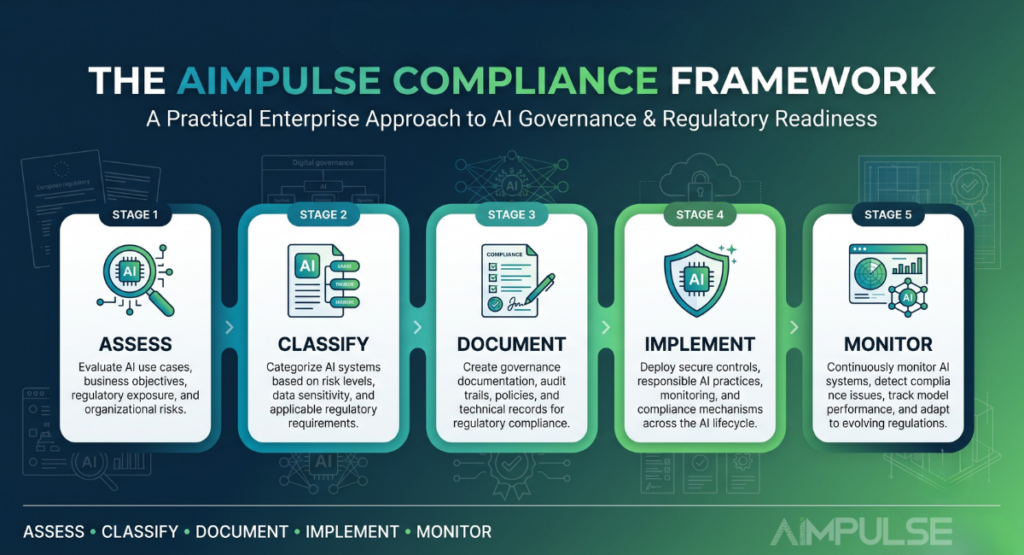
AImpulse supports European businesses through a structured five-stage framework for EU AI Act readiness:
- Assess — Inventory all AI systems and evaluate current governance maturity.
- Classify — Map each system against the Act’s risk tiers to determine applicable obligations.
- Document — Build the technical documentation, data governance records, and risk management files required for high-risk systems.
- Implement — Put oversight mechanisms, logging, and transparency measures into production systems.
- Monitor — Continuously track regulatory updates, system performance, and audit readiness over time.
Frequently Asked Questions
What is the EU AI Act?
The EU AI Act is a binding European regulation that governs how AI systems are developed and used, based on a risk classification model. It sets obligations ranging from outright prohibition for unacceptable-risk systems to transparency requirements for lower-risk applications like chatbots.
Who does the EU AI Act apply to?
It applies to providers, deployers, importers, and distributors of AI systems used within the EU, including non-EU companies whose AI outputs are used by EU-based individuals or organizations. Most enterprises operating in Europe will have some level of obligation.
What are the risk categories under the EU AI Act?
The Act defines four risk tiers: unacceptable risk (prohibited), high risk (strict obligations including documentation and oversight), limited risk (transparency requirements), and minimal risk (largely unregulated). Classification determines exactly what compliance work is required.
What should businesses do to prepare?
Businesses should inventory all AI systems, classify each against the Act’s risk tiers, and build documentation, oversight, and monitoring processes for anything falling into the high-risk category. Starting early avoids costly retrofits once deadlines are enforced.
How can AImpulse help with EU AI Act compliance?
AImpulse helps businesses assess, classify, and implement compliant AI systems using a structured five-stage framework. This includes technical documentation, governance processes, and monitoring designed to keep pace with the Act’s evolving requirements.
Conclusion
The EU AI Act represents a fundamental shift in how AI systems must be designed, documented, and governed across Europe. The businesses that adapt successfully are the ones treating compliance as a design principle from day one, not a retrofit exercise once deadlines are enforced. With obligations phasing in through 2026 and 2027, now is the time to inventory your AI systems, classify them accurately, and close any governance gaps before enforcement intensifies.
If your business needs help assessing AI compliance readiness or building AI products designed for responsible AI from the start, talk to AImpulse or follow AImpulse on LinkedIn for ongoing updates on AI regulation across Europe.