
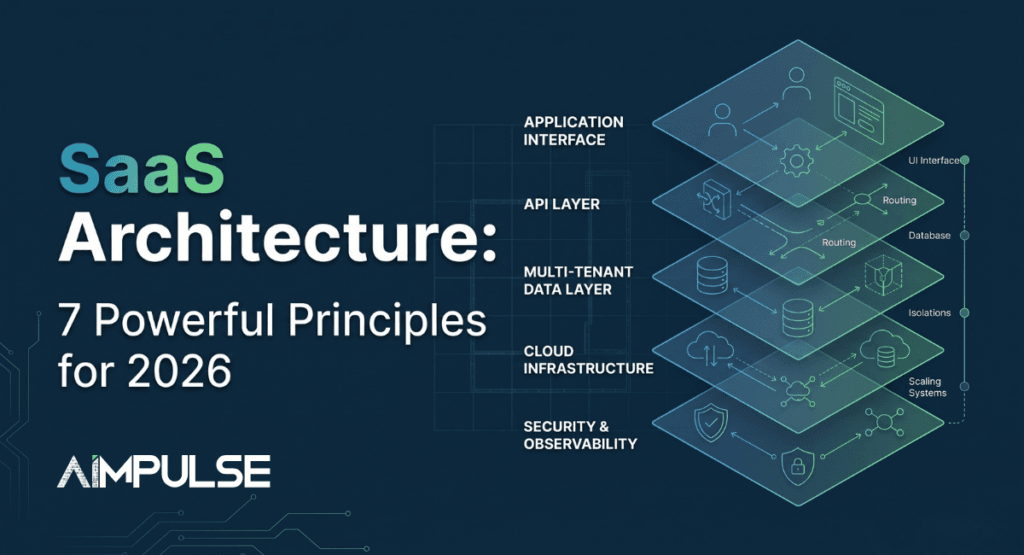
SaaS Architecture: 7 Powerful Principles for 2026
A SaaS product can begin with a simple plan: build the application, host it in the cloud, attract customers, and scale. In practice, growth creates decisions that a prototype rarely has to face.
As customer numbers rise, integrations multiply, data volumes increase, and enterprise requirements become more demanding, the architecture beneath the product matters more. Poor decisions can cause slow releases, unpredictable infrastructure costs, security risks, and difficult customer onboarding.
Good SaaS architecture supports the business you are building today while leaving room for the business it could become. This guide explains seven practical principles for planning secure, scalable SaaS in 2026, with special attention to business models, multi-tenant design, and the move beyond an MVP.
What Is SaaS Architecture?
SaaS architecture is the technical structure used to build, deliver, operate, and scale a software-as-a-service product. It defines how the application interface, backend services, APIs, databases, cloud infrastructure, authentication, integrations, storage, monitoring, security, and customer environments work together.
Unlike traditional software that customers install and manage themselves, the SaaS provider usually operates the application and its infrastructure. That means technical design influences much more than performance: it also affects subscription plans, onboarding, tenant isolation, support, reliability, and the cost of serving customers.
The architecture must support the application and the business delivering it, including customer onboarding, pricing, reliability, and ongoing operations.
Why SaaS Architecture Matters
An application that works for 50 customers may behave very differently when it serves 5,000. More users mean more data, traffic, integrations, support requests, and operational complexity. Enterprise customers can also introduce requirements for availability, identity management, isolation, compliance, performance, and data residency.
Architecture decisions should therefore reflect customer expectations and the commercial model, not just an engineering preference. A product designed for individual consumers may have very different tenancy and billing needs from a B2B platform selling to organizations with hundreds of employees.
For an example of how these decisions influence commercial software, explore AImpulse’s article on AI-powered SaaS platforms for enterprise growth.
7 Powerful Principles of SaaS Architecture
1. Design Architecture Around the Business Model
Before choosing frameworks or cloud services, define the product you intend to sell. Ask whether it is B2B or B2C, what counts as a customer or tenant, how subscriptions are priced, which features belong to each tier, and whether enterprise accounts require dedicated infrastructure or geographic controls.
Consider a hypothetical B2B SaaS platform with three plans: Starter, Business, and Enterprise. All three may share the same core application, while Enterprise customers could need single sign-on, audit exports, more restrictive access policies, or higher service levels.
Those are not just marketing decisions. They influence identity, entitlements, metering, data architecture, deployment options, and operating costs.
Write down the tenant definition, pricing model, required isolation level, and expected usage before selecting the architecture. The goal is to let the product support its business model instead of fighting it.
2. Choose the Right Tenancy Model
Multi-tenant SaaS architecture allows more than one customer or organization to use parts of the same software environment while keeping access and information appropriately separated. Multitenancy is not one fixed design; it is a range of trade-offs.
A shared application with a shared database allows multiple customers to use the same underlying services, with logical controls separating tenant data. It can be cost-efficient but requires careful isolation and authorization.
A shared application with separate databases keeps application services common while separating each customer’s data at the database level. This offers different isolation benefits, though database management and maintenance become more involved.
Dedicated infrastructure gives selected customers isolated application or infrastructure resources. It may suit particular enterprise requirements, but usually comes with greater operating cost and complexity.
A hybrid model may also be sensible: smaller accounts use shared resources, while selected enterprise customers receive dedicated components.
Do not choose the most isolated option automatically. Evaluate cost, isolation, performance, maintenance, compliance, and growth. Microsoft’s guidance on tenancy models explains these trade-offs in detail.
Whatever model you select, tenant identity must be enforced throughout authorization and data access—not merely shown as a filter in the interface.
3. Build APIs Into the Architecture
SaaS products rarely operate alone. Customers may expect connections with CRMs, ERPs, payment services, analytics tools, identity providers, AI systems, and internal enterprise software.
Treat APIs as a planned product capability, not an afterthought. A sensible API design considers authentication, authorization, versioning, error handling, rate limits, observability, documentation, and clear data contracts.
For example, if a customer integrates your SaaS with a billing platform, the integration should not break whenever your internal database changes. A stable API layer can reduce coupling and help support web, mobile, partner, and enterprise use cases.
Identify the integrations that are essential now, then design clear interfaces that allow more integrations later without exposing internal implementation details.
4. Make Cloud Infrastructure Scale With Demand
Hosting an application in the cloud does not automatically make it cloud-native. A scalable SaaS platform requires decisions about deployment, resilience, infrastructure automation, resource management, monitoring, and service communication.
Start with the needs you can justify. A modular application with automated deployments, appropriate database indexes, backups, and basic monitoring may serve an early-stage product better than a complex microservices environment.
As load grows, you may add caching, background jobs, queue-based processing, autoscaling, or infrastructure segmentation. Each choice should solve an observed reliability, performance, or capacity problem.
The AWS SaaS Lens design principles reinforce that there is no one-size-fits-all SaaS architecture. For a deeper explanation of implementation approaches, see our guide to cloud-native SaaS architecture.
Design for the next credible growth stage—not an imaginary customer count that forces unnecessary spending today.
5. Treat Security and Tenant Isolation as Architecture
Security is not a checklist to complete before launch. In a SaaS product, customers may share infrastructure, so a mistake in authorization or tenant identification can expose information across accounts.
The design should address:
Authentication, authorization, and tenant-scoped access checks
Data isolation and encryption
Secrets and credential management
Secure APIs and network boundaries
Audit logging, backup, and recovery
Security testing throughout development
For example, an API request asking for a project record should validate that the authenticated user has permission to access that record within the correct tenant. Simply knowing the record ID is not enough.
A secure software development lifecycle (SSDLC) helps teams address these controls from planning through operations. NIST’s Secure Software Development Framework is another useful foundation for secure engineering practices.
Test cross-tenant access explicitly and include isolation checks in ongoing security testing, not only initial implementation.
6. Build for Observability, Not Just Availability
Your SaaS platform may be online while one tenant experiences timeouts, a payment integration repeatedly fails, or a database query consumes too many resources. Availability alone does not tell you whether customers are receiving a reliable service.
Build visibility into application performance, infrastructure health, API errors, database behavior, security events, tenant-level usage, and infrastructure costs. Logs, metrics, and traces can help teams connect a problem to the customer and component affected.
Useful operational questions include: Which tenants are affected? What changed during the latest deployment? Is one account consuming disproportionate resources? What is the cost of supporting each plan?
Define a small set of service indicators and alerts that match user experience and business risk, then improve them as the platform grows.
7. Design for Evolution, Not Perfection
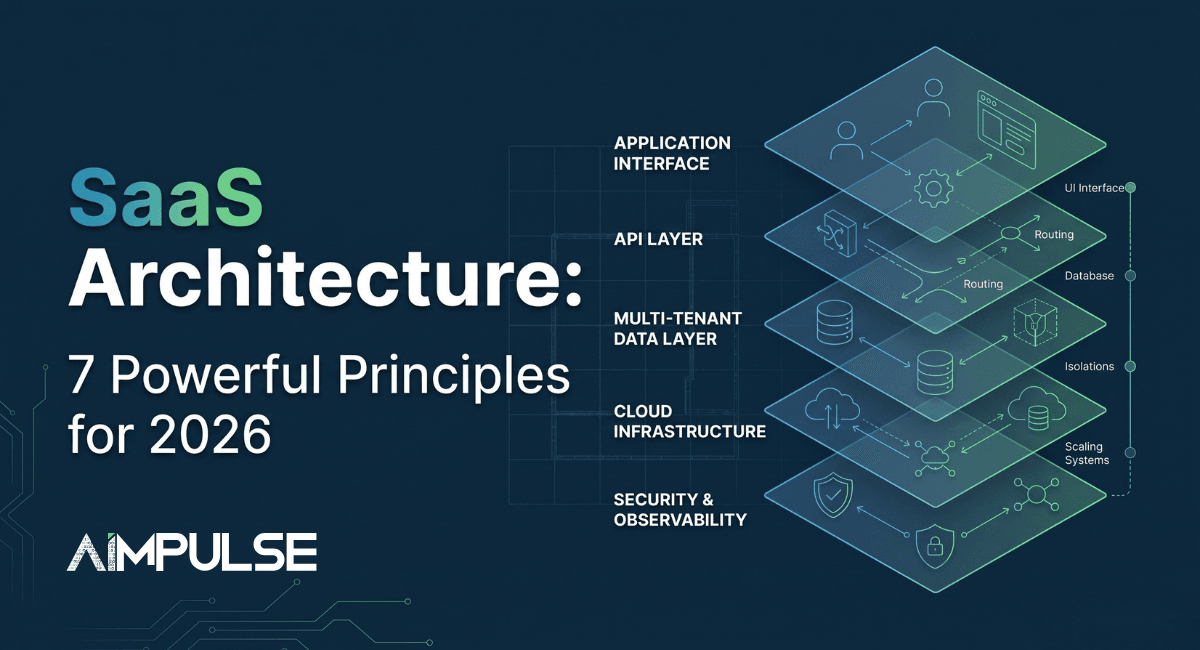
An early SaaS product does not need to look like a platform serving 100,000 customers. It needs clear boundaries and an architecture that can change without constant rewrites.
A startup might begin with:
Frontend → Backend → Database → Cloud
Later, real demand may justify:
Frontend → API layer → Services → Data stores → Messaging → Monitoring → Cloud infrastructure
Moving to microservices is not automatically an upgrade. The operational overhead can outweigh the benefits when a small team is still validating its product.
If your SaaS introduces AI capabilities, product evaluation, data flows, and model operations become additional design concerns. Our AI product engineering guide explores that part of the journey.
Make structural changes when evidence shows that the current design limits delivery, reliability, security, or economics—not simply because a different architecture looks more advanced.
When Should You Move Beyond Your MVP Architecture?
Not every startup needs Kubernetes, multiple databases, event-driven systems, or independent microservices at launch. A useful MVP architecture is one that helps the team learn quickly without creating obvious security or data-isolation risks.
Consider changes when you encounter:
Repeated deployment bottlenecks or slow releases
Persistent database or application performance limits
Reliability problems that affect multiple customers
Growing integration and feature-ownership complexity
New enterprise security, isolation, or residency requirements
Infrastructure costs that rise faster than customer value
For example, if heavy analytics queries slow down customer-facing transactions, isolating reporting workloads might be a better first step than rewriting every service. If enterprise accounts demand stronger data separation, a hybrid tenancy model may be more appropriate than migrating every customer to dedicated infrastructure.
Before a redesign, document the actual bottleneck, compare options, estimate operational cost, and define how success will be measured. If the product idea itself is still uncertain, prioritize validating the startup opportunity before building a larger MVP.
Common SaaS Architecture Mistakes
Building Microservices Too Early
Microservices can help independent teams and workloads, but they also add deployment, networking, monitoring, and operational complexity. A modular monolith is often a more practical starting point.
Ignoring Multitenancy Until Later
A B2B SaaS business should decide early how tenants are identified and their data is protected. Retrofitting isolation after the product has grown can be difficult and risky.
Treating Security as a Feature
Security belongs across identity, application logic, APIs, infrastructure, and data—not in a single feature or final audit.
Building Without Observability
Without reliable telemetry, engineers are left guessing why a customer experiences a failure or why operating costs increase.
Forgetting Infrastructure Economics
A product can scale technically and still become financially unsustainable. Monitor usage and cost as the customer base grows, especially when subscription plans have very different consumption patterns.
The AImpulse SaaS Architecture Framework
At AImpulse, we use five connected stages to translate business requirements into an architecture that can grow with the product.
Define
Understand the product, customers, business model, subscription needs, and realistic growth requirements.
Structure
Design the application, data, API, and tenancy architecture around those needs.
Secure
Include authentication, authorization, customer isolation, infrastructure security, and operational controls.
Scale
Design cloud infrastructure and services that can evolve as demand increases.
Optimize
Continuously improve performance, reliability, developer productivity, and infrastructure economics.
DEFINE → STRUCTURE → SECURE → SCALE → OPTIMIZE
The objective is not to create the most complicated architecture. It is to choose the right structure for the product’s current stage and next credible stage.
How AImpulse Helps
Building a successful SaaS product requires more than application code. Product strategy, user experience, software engineering, APIs, cloud, security, AI, and operations need to support one another.
AImpulse helps teams plan product architecture, develop cloud-native applications, design tenant-aware systems, integrate APIs and AI services, build secure software, modernize existing products, and move from MVP to production.
For businesses connecting technology to a go-to-market strategy, AImpulse Studio brings together product development and growth-oriented capabilities. The most useful architecture is one that helps the product become easier to operate, improve, and sell—not harder to change.
Frequently Asked Questions
What is SaaS architecture?
SaaS architecture is the technical structure used to build, operate, secure, and scale software delivered as a service. It covers the application, databases, APIs, cloud infrastructure, identity, integrations, and operational systems.
What is a multi-tenant SaaS architecture?
A multi-tenant SaaS architecture allows multiple customers or organizations to use shared software components while maintaining appropriate separation of data, configuration, access, and resources.
Is multi-tenancy necessary for SaaS?
Not always. Many SaaS products use shared resources, but dedicated or hybrid approaches may better fit certain customers, compliance requirements, or pricing models.
What is cloud-native SaaS architecture?
Cloud-native SaaS architecture uses cloud capabilities and engineering practices to support scalable deployment, resilience, automation, observability, and efficient operations.
Should a SaaS startup use microservices?
Not necessarily. A modular monolith may be simpler to build and operate at an early stage. Microservices become useful when real technical or organizational constraints justify their complexity.
How do you make SaaS architecture scalable?
Start with sound application and data design, tenant-aware access, reliable APIs, automation, and monitoring. Add caching, asynchronous workloads, and infrastructure scaling when measurements show they are needed.
What is the biggest SaaS architecture mistake?
Treating architecture as a purely technical decision. Architecture should reflect the product’s customer requirements, business model, security, pricing, team capabilities, and credible growth plans.
Final Thoughts
Great SaaS architecture is not about predicting everything that could happen years from now. It is about making sound decisions for the business you are building today while creating room for tomorrow.
Build faster → Serve customers reliably → Integrate easily → Operate securely → Scale intelligently.
As SaaS products connect more deeply with APIs, cloud platforms, AI, and enterprise systems, architecture becomes a business capability—not only a technical foundation.
Ready to build a SaaS product that can scale beyond the MVP? Talk to AImpulse about defining the architecture for your next stage of growth.